

One minute from Aris Grand-Place hotel and two minutes from Alma Grand-Place, the Galeries Royales Saint-Hubert are Brussels’ most architecturally distinguished interior space and one of the most historically significant covered arcades in Europe. Opened on 20 July 1847 by King Leopold I, they predate Milan’s Galleria Vittorio Emanuele II by twenty years. They are the oldest pedestrian route in the city, and they remain, 178 years after their inauguration, in daily use as a place of commerce, culture and shelter from the Brussels rain.
This guide covers the architecture, the history, the shops worth visiting, and what most visitors miss.
The covered arcade Brussels didn’t yet know it needed
In the 1830s, Brussels had no proper pedestrian connection between the Grand-Place and the theatre and exchange quarter to the north. The rue Saint-Hubert a crooked, narrow alley occupied the site. Four bankers presented a proposal to the city council on 13 December 1837: a covered passage on an entirely different scale from the Parisian arcades that had gone up earlier in the century.
The architect chosen was Jean-Pierre Cluysenaar (1811–1880). His design was radical in its ambition. Where the Parisian passages were narrow (typically 2 to 3 metres wide) and low, Cluysenaar’s galleries would be 8.3 metres wide and 213 metres long, beneath a continuous iron and glass vault 18 metres high. The floor would be laid in blue limestone and Belgian Rouge Royal marble. The facades, in an Italianate Renaissance style, would carry two upper floors with attics above the glazing.
Negotiating the property rights required nine years. Several blocks of housing were demolished without compensation to their residents. The state had to take a financial share because the project was too large for private developers alone. The galleries opened on 20 July 1847, the Belgian national holiday, in the presence of King Leopold I and his two sons. They were, at that moment, the longest, widest, highest and best-lit covered galleries in the world.
Shopping the Galeries Brussels: what is here today

The three sections of the arcade, Galerie du Roi, Galerie de la Reine and Galerie des Princes, house over 50 ground-floor shops, with apartments and offices on the floors above.
The addresses worth knowing:
Neuhaus: the chocolate house that invented the Belgian praline in 1912, in this exact location. Jean Neuhaus Jr., working in his grandfather’s apothecary at the entrance to the Galerie de la Reine, created the first filled chocolate shell. The ballotins, the distinctive gold boxes were designed by his wife, Louise Agostini, the same year. The shop remains in the Galeries today. As we covered in our guide to the best chocolate shops in Brussels, Neuhaus is the natural first stop for pralines.
Delvaux: Belgium’s own luxury leather goods house, founded in Brussels in 1829, has a boutique in the Galeries. The Brillant bag, introduced in 1958, is the house’s signature. As noted in our luxury shopping guide, Delvaux predates Louis Vuitton by 25 years and remains Belgium’s most internationally recognised fashion export.
Yvan’s: the Brussels jewellery and watchmaking house founded in 1955, Belgium’s first official Rolex concessionaire, maintains a boutique in the Galeries alongside its new location opening on the Place du Grand Sablon in summer 2026.
Tropismes: one of Brussels’ finest bookshops, with a particular strength in French-language literature, art and architecture. The interior high ceilings, wooden shelves, natural light from the arcade vault, makes it one of the most pleasant places to browse books in Belgium.
Théâtre Royal des Galeries: a working theatre within the arcade, presenting a year-round programme of productions in French. The façade, facing the Galerie de la Reine, is one of the arcade’s architectural highlights.
The Galeries in December: shopping at its most atmospheric
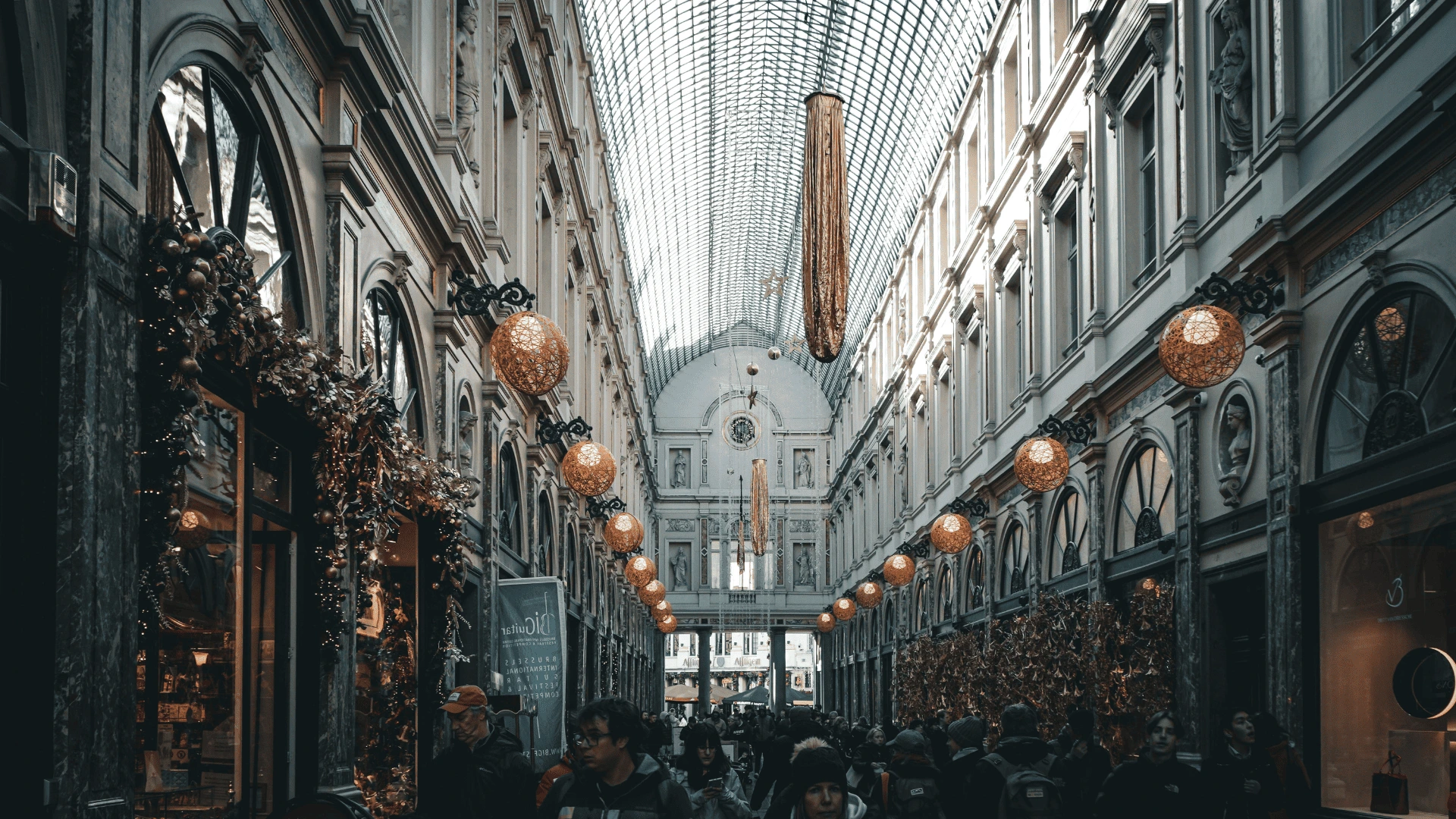
In December, the Galeries Royales Saint-Hubert take on a quality that no other covered space in Brussels quite replicates. The iron and glass vault holds the warm air from the shops below, the praline scent from Neuhaus intensifies in the cold, and the acoustic quality of the arcade, which amplifies footsteps and conversation equally, gives the space a theatrical intimacy.
The Galeries connect the area of the Grand-Place (to the south, via rue de l’Écuyer) to the rue des Bouchers and rue d’Argent quarter (to the north). For guests staying at Aris hotel or Alma hotel, they are not a destination but a route, one that happens to pass through one of Europe’s most beautiful 19th-century interiors. That distinction matters. The Galeries reward the traveller who walks through them without an agenda, pausing where the mood suggests.
For the record: at number 7 in the Galerie du Roi, on 1 March 1896, the Lumière brothers held one of the earliest public film projections in history, in a first-floor room of what was then the offices of the newspaper La Chronique. The Galeries have been a cultural venue since before cinema was cinema.
Practical information: visiting the Galeries
- Address: Galerie du Roi 5, 1000 Brussels entrance from rue des Bouchers, rue de l’Écuyer and rue d’Arenberg
- Distance from Aris Grand-Place hotel: 1 minute on foot
- Distance from Alma Grand-Place hotel: 2 minutes on foot
- Opening hours: The arcade itself is open 24 hours as a public pedestrian route. Individual shops follow standard Belgian retail hours (approximately 10:00–18:30, Monday to Saturday; reduced Sunday hours)
- Entry: Free
- Guided tours: Available through visit.brussels recommended for guests interested in the architecture and history in depth
