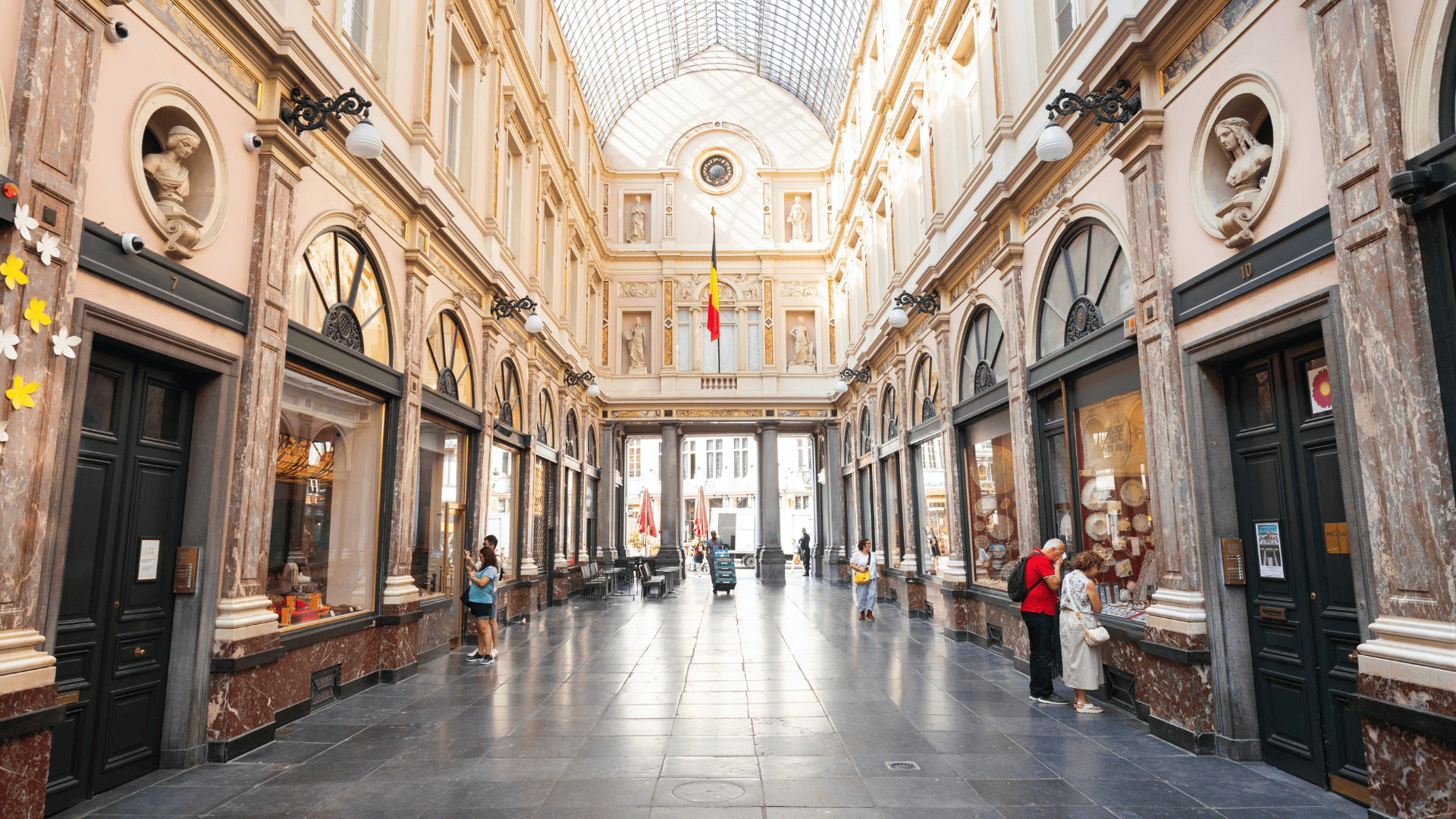
One minute from Aris Grand-Place hotel and two minutes from Alma Grand-Place, the Galeries Royales Saint-Hubert are Brussels’ most architecturally distinguished interior space and one of the most historically significant covered arcades in Europe. Opened on 20 July 1847 by King Leopold I, they predate Milan’s Galleria Vittorio Emanuele II by twenty years. They are the oldest pedestrian route in the city, and they remain, 178 years after their inauguration, in daily use as a place of commerce, culture and shelter from the Brussels rain.
This guide covers the architecture, the history, the shops worth visiting, and what most visitors miss.
The covered arcade Brussels didn’t yet know it needed
In the 1830s, Brussels had no proper pedestrian connection between the Grand-Place and the theatre and exchange quarter to the north. The rue Saint-Hubert a crooked, narrow alley occupied the site. Four bankers presented a proposal to the city council on 13 December 1837: a covered passage on an entirely different scale from the Parisian arcades that had gone up earlier in the century.
The architect chosen was Jean-Pierre Cluysenaar (1811–1880). His design was radical in its ambition. Where the Parisian passages were narrow (typically 2 to 3 metres wide) and low, Cluysenaar’s galleries would be 8.3 metres wide and 213 metres long, beneath a continuous iron and glass vault 18 metres high. The floor would be laid in blue limestone and Belgian Rouge Royal marble. The facades, in an Italianate Renaissance style, would carry two upper floors with attics above the glazing.
Negotiating the property rights required nine years. Several blocks of housing were demolished without compensation to their residents. The state had to take a financial share because the project was too large for private developers alone. The galleries opened on 20 July 1847, the Belgian national holiday, in the presence of King Leopold I and his two sons. They were, at that moment, the longest, widest, highest and best-lit covered galleries in the world.
Shopping the Galeries Brussels: what is here today

The three sections of the arcade, Galerie du Roi, Galerie de la Reine and Galerie des Princes, house over 50 ground-floor shops, with apartments and offices on the floors above.
The addresses worth knowing:
Neuhaus: the chocolate house that invented the Belgian praline in 1912, in this exact location. Jean Neuhaus Jr., working in his grandfather’s apothecary at the entrance to the Galerie de la Reine, created the first filled chocolate shell. The ballotins, the distinctive gold boxes were designed by his wife, Louise Agostini, the same year. The shop remains in the Galeries today. As we covered in our guide to the best chocolate shops in Brussels, Neuhaus is the natural first stop for pralines.
Delvaux: Belgium’s own luxury leather goods house, founded in Brussels in 1829, has a boutique in the Galeries. The Brillant bag, introduced in 1958, is the house’s signature. As noted in our luxury shopping guide, Delvaux predates Louis Vuitton by 25 years and remains Belgium’s most internationally recognised fashion export.
Yvan’s: the Brussels jewellery and watchmaking house founded in 1955, Belgium’s first official Rolex concessionaire, maintains a boutique in the Galeries alongside its new location opening on the Place du Grand Sablon in summer 2026.
Tropismes: one of Brussels’ finest bookshops, with a particular strength in French-language literature, art and architecture. The interior high ceilings, wooden shelves, natural light from the arcade vault, makes it one of the most pleasant places to browse books in Belgium.
Théâtre Royal des Galeries: a working theatre within the arcade, presenting a year-round programme of productions in French. The façade, facing the Galerie de la Reine, is one of the arcade’s architectural highlights.
The Galeries in December: shopping at its most atmospheric
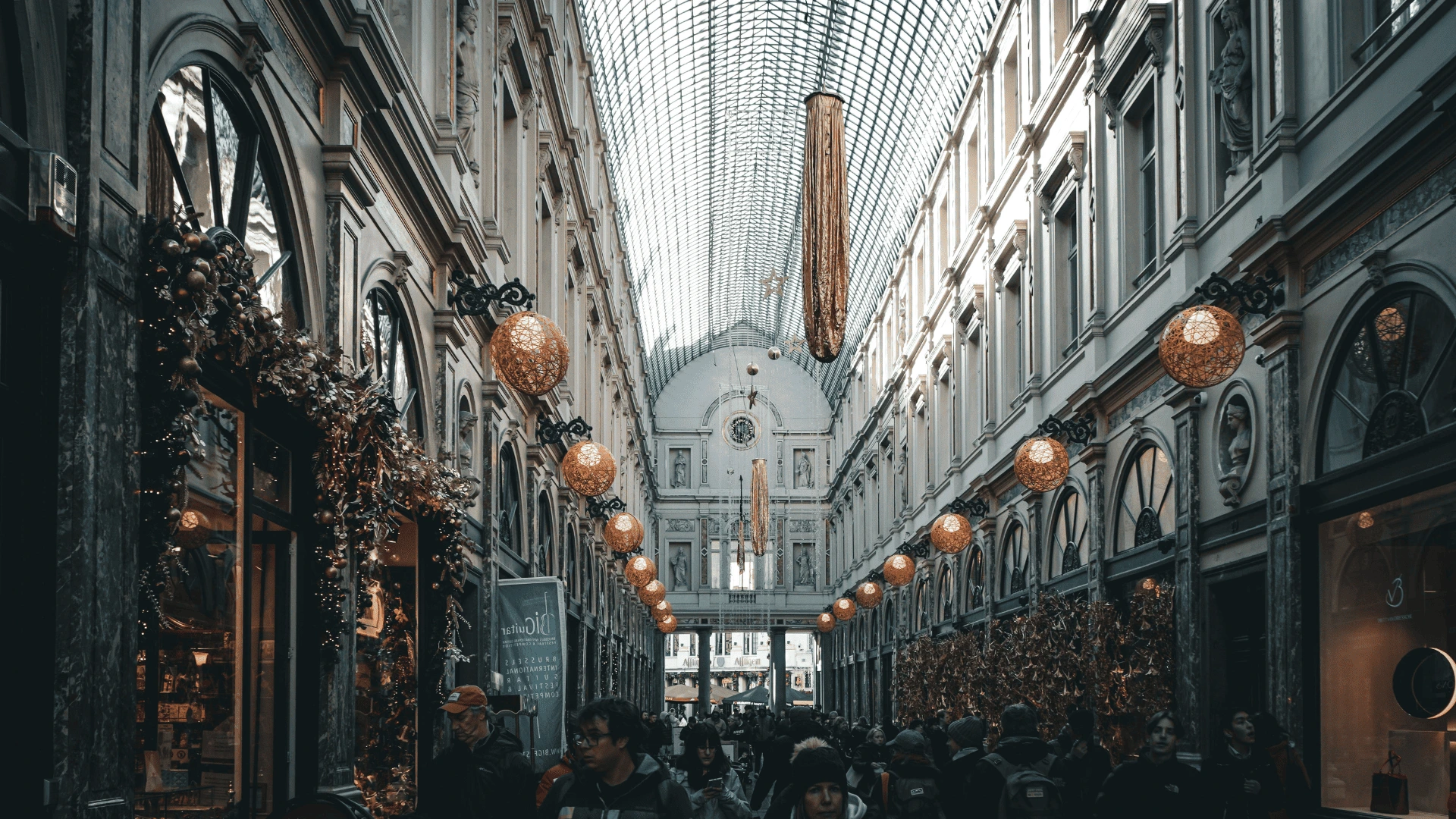
In December, the Galeries Royales Saint-Hubert take on a quality that no other covered space in Brussels quite replicates. The iron and glass vault holds the warm air from the shops below, the praline scent from Neuhaus intensifies in the cold, and the acoustic quality of the arcade, which amplifies footsteps and conversation equally, gives the space a theatrical intimacy.
The Galeries connect the area of the Grand-Place (to the south, via rue de l’Écuyer) to the rue des Bouchers and rue d’Argent quarter (to the north). For guests staying at Aris hotel or Alma hotel, they are not a destination but a route, one that happens to pass through one of Europe’s most beautiful 19th-century interiors. That distinction matters. The Galeries reward the traveller who walks through them without an agenda, pausing where the mood suggests.
For the record: at number 7 in the Galerie du Roi, on 1 March 1896, the Lumière brothers held one of the earliest public film projections in history, in a first-floor room of what was then the offices of the newspaper La Chronique. The Galeries have been a cultural venue since before cinema was cinema.
Practical information: visiting the Galeries
- Address: Galerie du Roi 5, 1000 Brussels entrance from rue des Bouchers, rue de l’Écuyer and rue d’Arenberg
- Distance from Aris Grand-Place hotel: 1 minute on foot
- Distance from Alma Grand-Place hotel: 2 minutes on foot
- Opening hours: The arcade itself is open 24 hours as a public pedestrian route. Individual shops follow standard Belgian retail hours (approximately 10:00–18:30, Monday to Saturday; reduced Sunday hours)
- Entry: Free
- Guided tours: Available through visit.brussels recommended for guests interested in the architecture and history in depth
The Brussels Christmas Market is one of Europe’s largest and most visited winter festivals, nearly 2.5 million visitors over five weeks, across nine squares and a 2.5 kilometre trail of lights connecting the historic city centre. Known officially as Winter Wonders (Plaisirs d’Hiver in French), it transforms Brussels from late November into something that is genuinely difficult to describe without resorting to the word magical.
This year, Brussels Christmas 2026 runs from Friday 27 November 2026 to Sunday 3 January 2027. Markets are open daily from noon to 10pm, closing at 6pm on Christmas Eve (24 December) and New Year’s Eve (31 December).
Winter Wonders Brussels: a festival across nine locations
What makes the Brussels Christmas Market different from most European equivalents is its scale across the city centre. Nine distinct squares each have their own atmosphere and offer, connected by the illuminated trail. Here is where to go and what to expect.
Grand-Place: the unmissable centrepiece
The Grand-Place hosts the Christmas tree and the festival’s most spectacular attraction: a 360° sound and light show projected onto the guild house facades, running nightly from 5pm to 10pm (until 10:30pm on Fridays and Saturdays). The show runs every 30 minutes. Arrive early on weekends, the square fills up. On weekday evenings the atmosphere is considerably more intimate.
Vismet / Place Sainte-Catherine: the main market
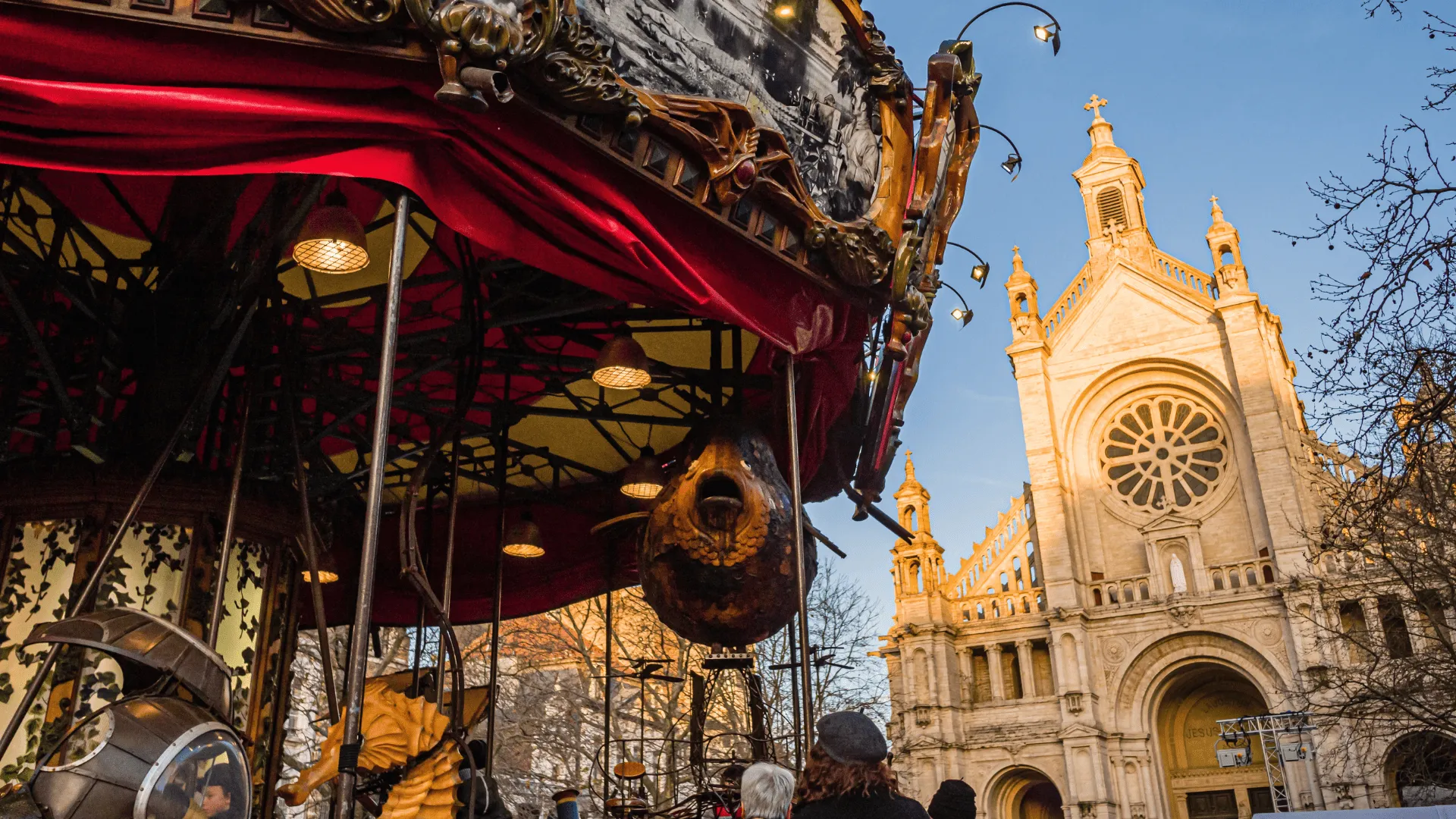
This is where the majority of the 200+ wooden chalets are concentrated: food stalls, artisanal gifts, mulled wine, Belgian waffles and bûches de Noël. The Ferris wheel at Place Sainte-Catherine offers views over the lit city. The merry-go-round and Stella Artois Pavilion complete a square that feels genuinely festive rather than purely commercial. Worth a long evening.
Place de Brouckère: ice skating and curling
The ice rink and curling lanes at Place de Brouckère are the family highlight of Winter Wonders. No equipment needed, skate hire is available on site. Book ahead for weekend sessions; they fill up quickly. Santa’s Reindeer merry-go-round operates alongside.
Mont des Arts: the light installation
The terraced garden between the Royal Library and the Magritte Museum becomes a light installation for the duration of Winter Wonders. Less crowded than the main squares, and one of the best viewpoints in the city at night.
Rue de la Madeleine and Galerie Bortier: the artisan circuit
Rue de la Madeleine runs directly between the Grand-Place and Brussels Central Station, a five-minute walk from the hotels, and hosts a row of Christmas chalets that most visitors miss. The adjacent Galerie Bortier houses the Creators Factory: artisan chalets selected for the quality of their craft. For guests looking to buy gifts rather than souvenirs, this is the circuit worth seeking out.
Brussels Christmas 2026: what to eat and drink
No visit to the Brussels Christmas market is complete without engaging seriously with the food. The winter staples are everywhere, glühwein, hot chocolate, speculoos, pain d’épices, but Brussels adds its own layer to the standard Christmas market offer.
Look for: gaufres de Liège (dense, caramelised, eaten warm from the stall, entirely different from the tourist waffles sold near the Grand-Place year-round), carbonnade flamande served in bread bowls at several stalls near Place Sainte-Catherine, and kriek or faro, Brussels’ own lambic-based beers, available at the more discerning stalls and at several bars along the trail.
For a proper sit-down meal after an evening at the market, our guide to where to eat in Brussels near Grand-Place covers the addresses worth booking in advance for December.
When to visit: timing your Brussels Christmas market trip
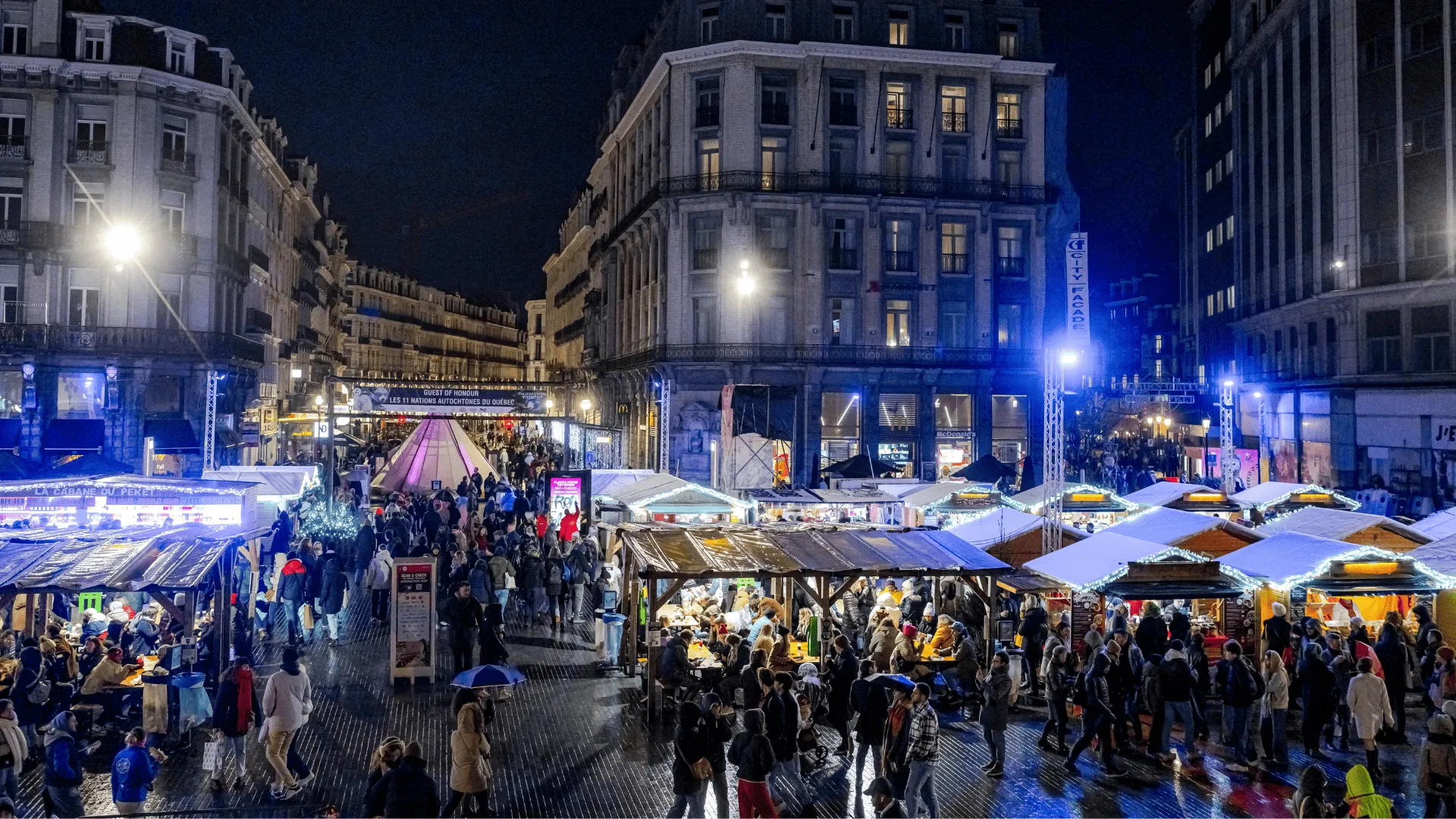
Weekday evenings are consistently the best experience: the stalls are fully open, the light show runs on schedule, the crowds are manageable. Avoid Saturday afternoons in December, the Grand-Place and Vismet areas become very dense between 3pm and 7pm.
The opening week (late November) is worth considering for guests who want the full atmosphere without peak-season prices and crowds. The market is fully operational from day one, hotels are less expensive, and the novelty of the season is at its height.
Christmas week itself (24–27 December) is beautiful but busy. Book well in advance and confirm your reservation directly, booking direct on our official website guarantees the best available rate, with no intermediary fees, as detailed on our Alma hotel and Aris hotel offers page.
If you are planning to extend your stay into the new year, our article on New Year’s Eve in Brussels covers what to expect on 31 December.
Getting to Brussels for Winter Wonders
Eurostar from London St Pancras reaches Brussels in under two hours a direct, city-centre to city-centre connection. Brussels Central Station is a five-minute walk from Alma Grand-Place and Aris Grand-Place hotels. From Paris, the Thalys takes approximately 1h22. From Amsterdam, 1h49.
By car, parking in the city centre during Winter Wonders is not recommended. The Interparking Grand-Place facility, two minutes from both hotels is open 24/7 and is the most practical option for guests arriving by car. Full transport information is on our FAQs page.
Planning what to do in Brussels with kids? You are better placed than you think. Brussels is one of Europe’s most genuinely family-friendly cities compact, walkable, full of interactive museums, chocolate workshops and comic strip murals that children remember long after the trip. As hosts near Grand-Place, we have helped hundreds of families plan their Brussels family activities from this neighbourhood. A six-year-old visiting for the first time will not remember the European Parliament. They will remember the 61-centimetre bronze statue urinating in the middle of the city while a hundred tourists photograph it in delight.
Brussels family activities within walking distance: start in the neighbourhood
The Grand-Place itself is the first stop. At child height, the guild house facades are overwhelming in the best possible way the gold, the scale, the guild symbols carved into stone. Walk south five minutes and you reach the Manneken Pis: smaller than every child expects, funnier than any photograph suggests. On certain days, check the official city calendar, he appears in one of his 900 costumes, and the unveiling ceremony draws a genuinely enthusiastic crowd.
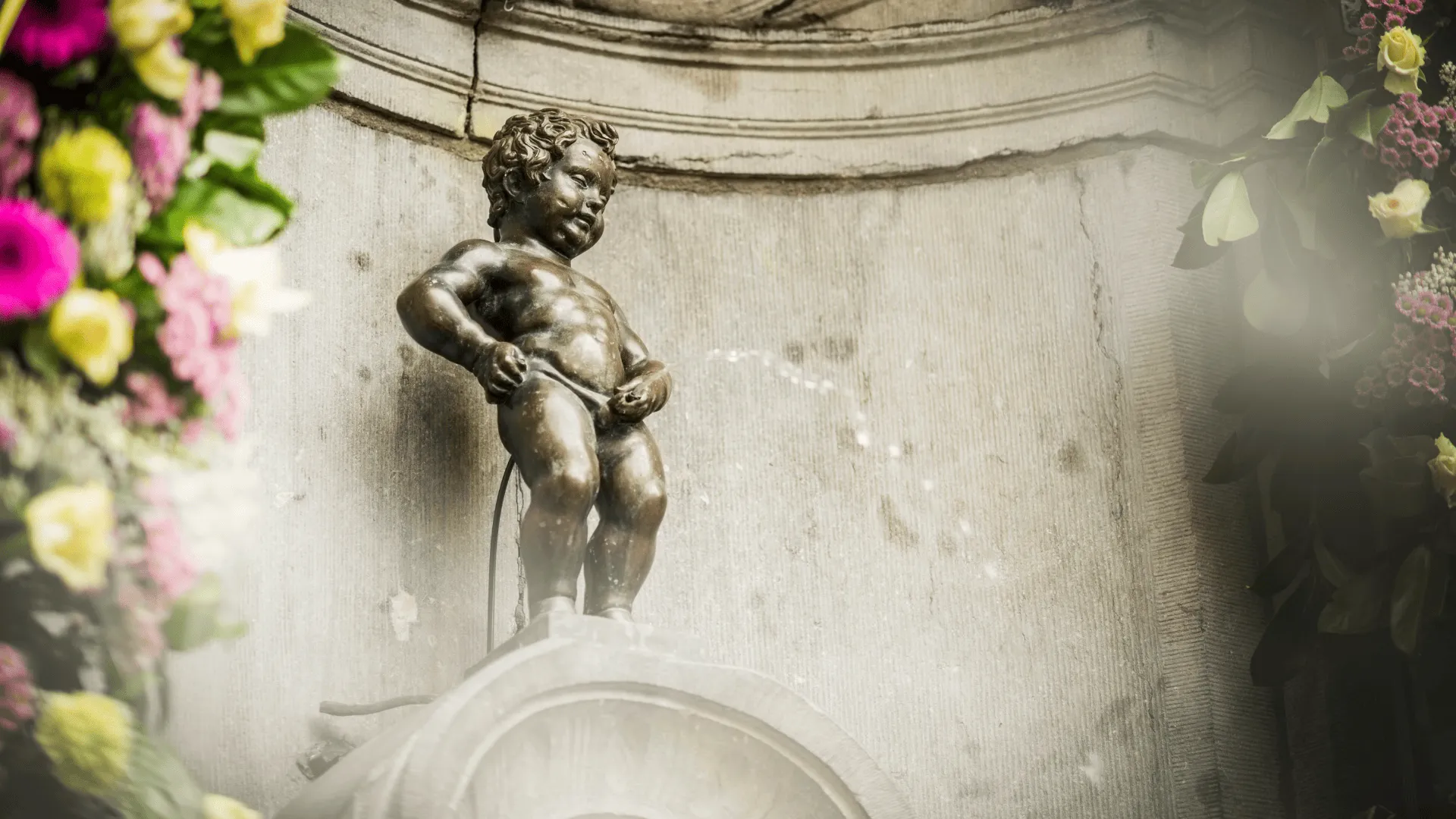
Two minutes further along rue de l’Étuve, the Jeanneke Pis the female counterpart, added in 1987 is tucked into a small alley off rue du Chêne. Most visitors miss it entirely. Children find this extremely satisfying.
Choco Story Brussels: chocolate, explained and tasted
On rue de l’Étuve, steps from the Manneken Pis, Choco Story Brussels is exactly what it sounds like: the history of chocolate told interactively, ending with a live demonstration by a master chocolatier and a tasting. The museum covers the origins of cacao in Central America, the journey of chocolate to Europe, and the Belgian contribution to its evolution.
For children aged 6 and above it is genuinely engaging, not a tourist gimmick, but a well-designed museum with real content. For adults, the demonstration alone is worth the entry price.
- Address: Rue de l’Étuve 41, 1000 Brussels, 5 minutes from the hotel
- Hours: Daily 9:00–18:00, weekends from 10:00
- Price: €15 adults · reduced rates for children
The Belgian Comic Strip Centre: Brussels’ favourite cultural export
Belgium invented the comic strip as we know it. Tintin, the Smurfs, Lucky Luke, Spirou, none of them are from France. The Belgian Comic Strip Centre on rue des Sables documents this history with enough energy and colour to hold the attention of children who have never read a single album.
The permanent 3D Smurf village is the highlight for younger visitors. The building itself, Victor Horta’s 1906 Waucquez warehouse is an Art Nouveau masterpiece that adults will notice even if children do not.
Before or after the museum, follow the free comic strip wall trail through the streets of Brussels: over 50 giant murals painted on building gables across the city centre, each featuring a different Belgian comic character. It is a genuine urban treasure hunt that costs nothing and takes as long as you want.
- Address: Rue des Sables 20, 1000 Brussels, 12 minutes from the hotel
- Hours: Tuesday to Sunday. Closed Mondays.
- Price: €14 adults · reduced for children
Atomium and Mini-Europe: the classic Brussels family day
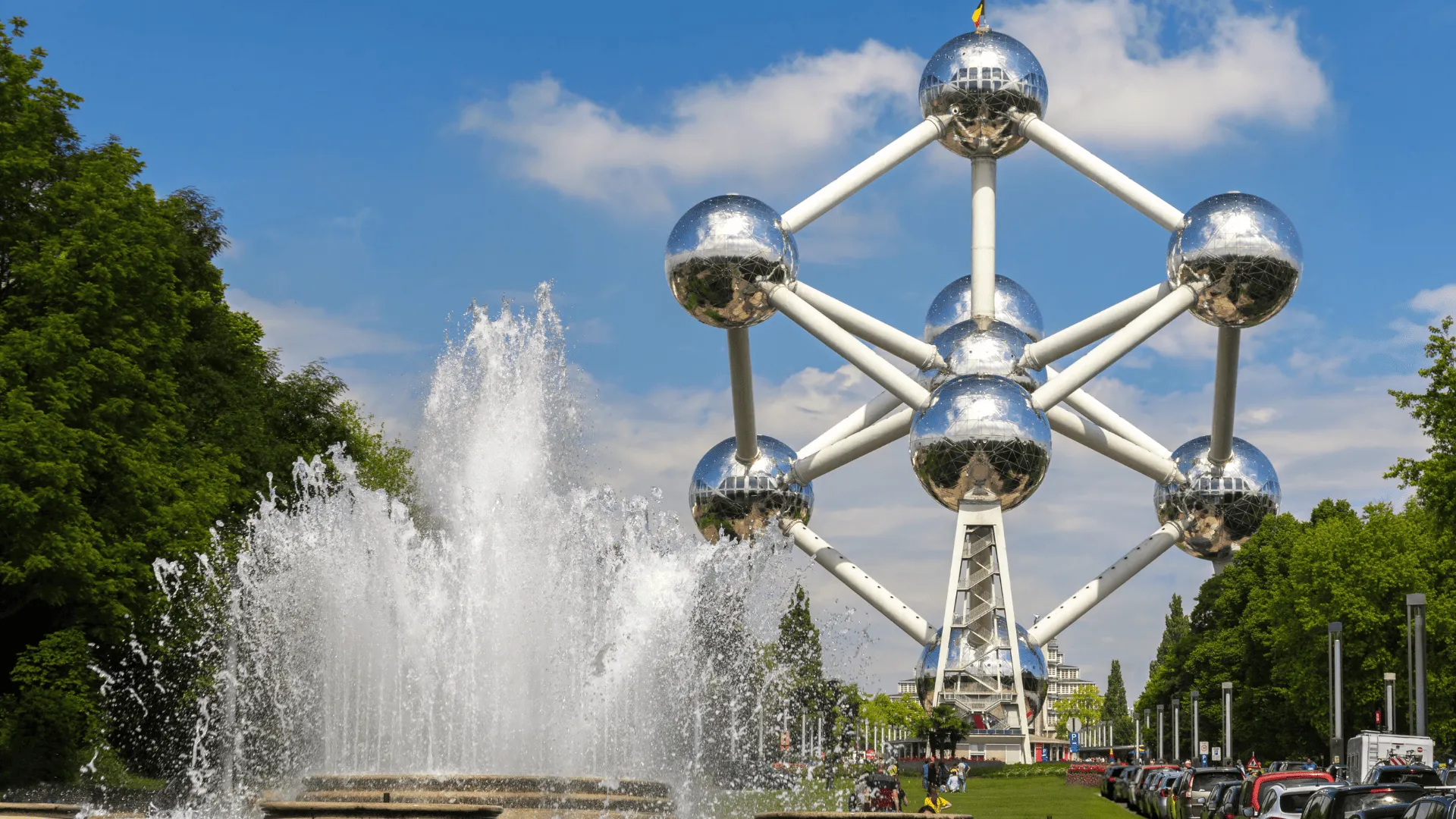
No family visit to Brussels is complete without the Atomium. The nine connected steel spheres built for the 1958 World’s Fair rise 102 metres above Laeken, visible from much of the city and genuinely unlike anything children will have seen before. Inside, the panoramic views from the top sphere and the exhibition on the 1958 Expo are the highlights for older children. For younger ones, simply being inside a giant steel ball is enough.
Adjacent, Mini-Europe offers a compact tour of the continent in miniature scale, the Eiffel Tower at knee height, a working model of Vesuvius that erupts every few minutes, and Big Ben reduced to something a child could theoretically pick up. Allow a full morning for both.
Getting there: Tram lines 7 or 51 from the city centre, approximately 30 minutes. Children under 6 travel free on the STIB network when accompanied by a fare-paying adult. Children aged 6 to 11 can obtain a free J-pass at any STIB Bootik, worth collecting before your visit.
The family hotel in Brussels at the centre of it all
Both Alma Grand-Place hotel and Aris Grand-Place hotel offer a Family Duplex, a split-level room across two bedrooms with two separate bathrooms, sleeping up to five people. It is the most practical configuration for families visiting Brussels, combining privacy for parents with space for children.
Wondering where to eat in Brussels near the Grand-Place? One of the great pleasures of staying in this neighbourhood is the sheer density of good dining in Brussels within walking distance, and not all of it is obvious from the outside.
Beneath the cobblestones and awnings, there are genuinely excellent addresses: neighbourhood brasseries that have been serving moules-frites for decades, newer canteens built on Belgian tradition, and a bistro on the Sablon that earns its Michelin recognition quietly year after year.
At Alma Grand-Place and Aris Grand-Place, we are asked every day by our guests: where should we eat? This is our honest answer.
Start the morning right: Lloyd Coffee Eatery
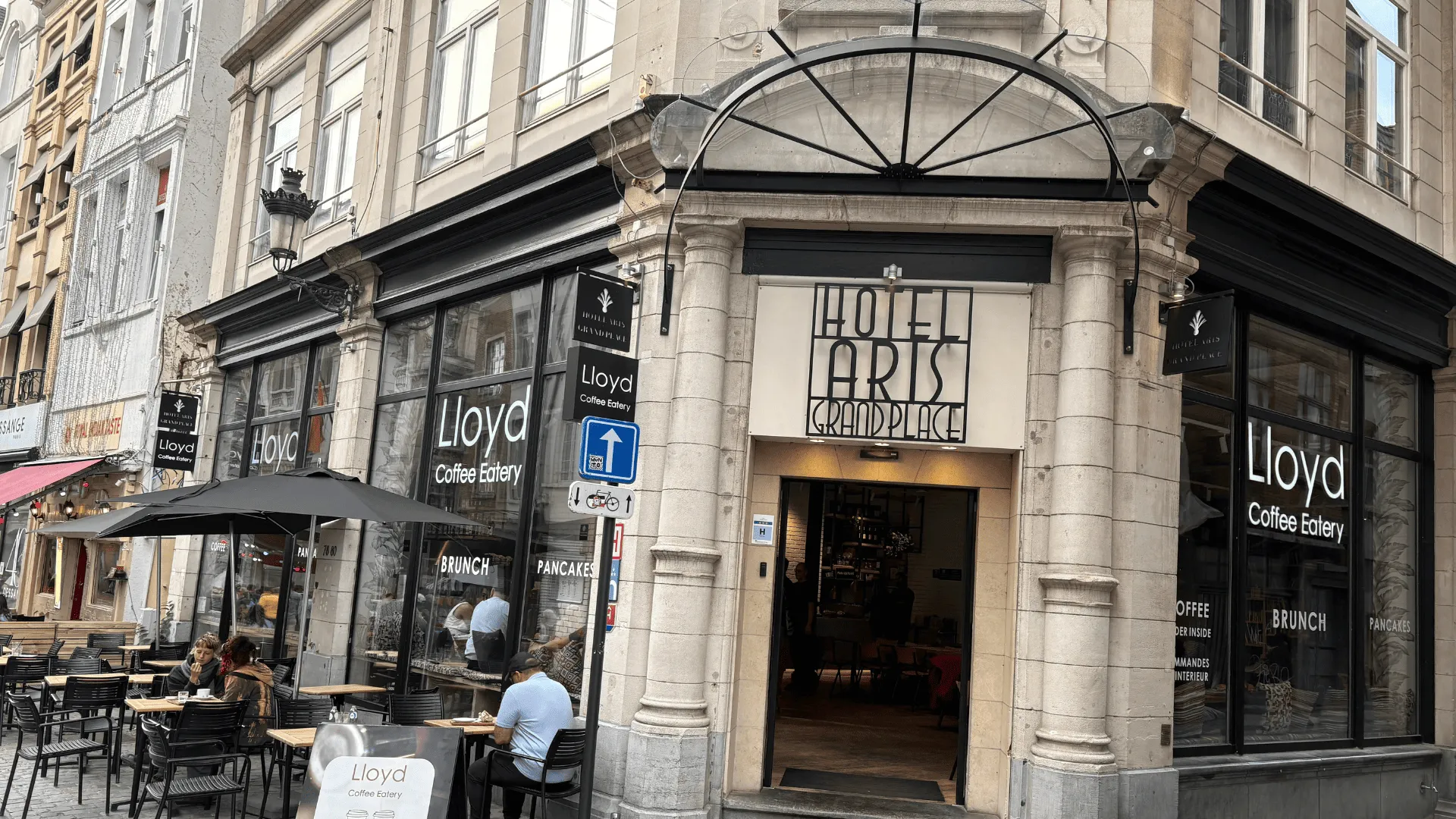
Before heading out to explore the city, breakfast matters. Our partner Lloyd Coffee Eatery serves breakfast at both hotels every morning. It is a Brussels institution: quality coffee, fresh pastries and a seasonal approach to morning food that sets the tone for a good day.
Breakfast is available Monday to Friday from 7:00 am to 10:00 am, and on weekends until 11:00 am. It can be added to your booking or paid on arrival.
Dining in Brussels the authentic way: Bouillon Bruxelles
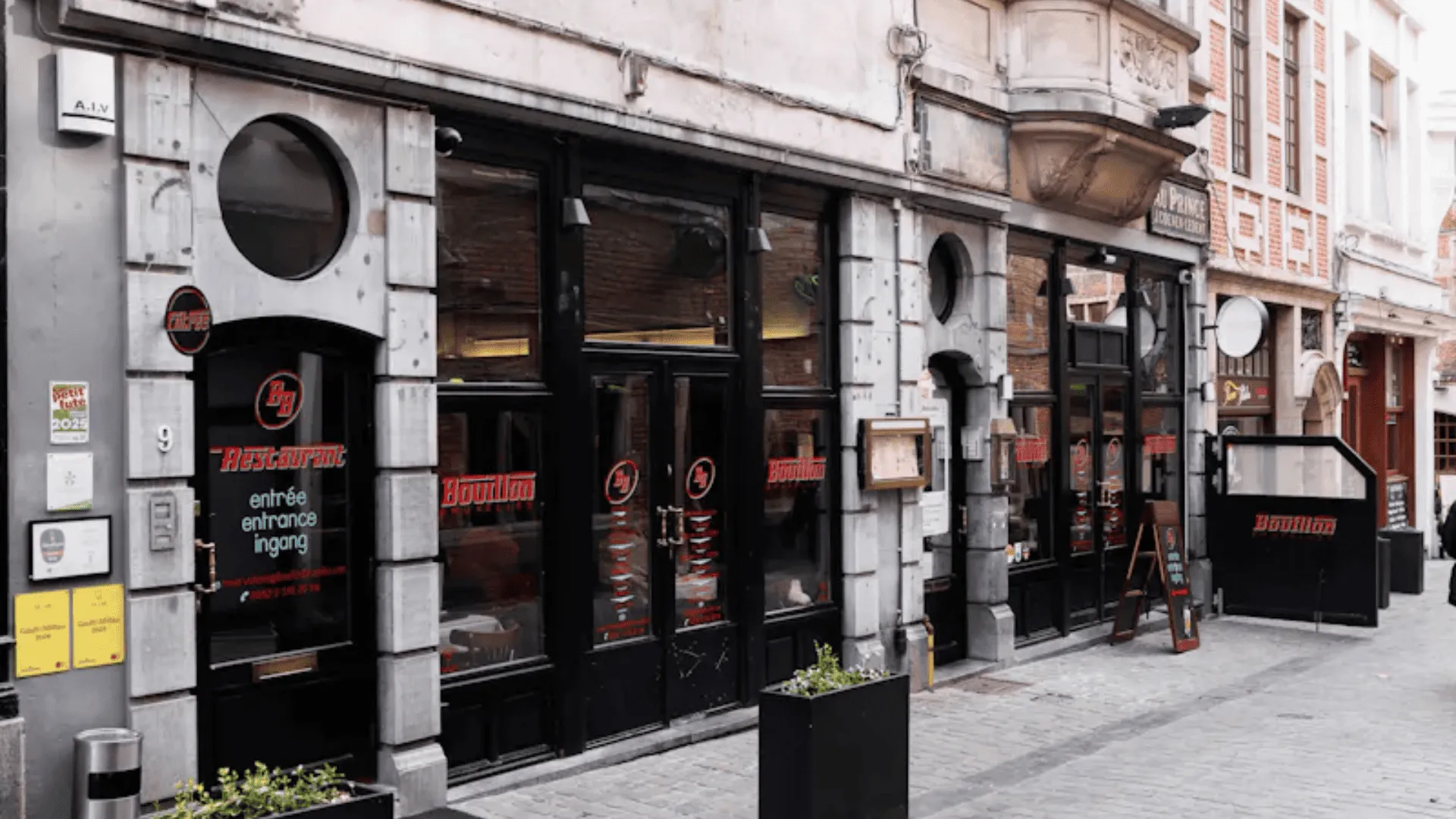
A five-minute walk from Alma hotel, Bouillon Bruxelles on the Rue des Dominicains is one of the most satisfying lunch addresses in central Brussels. The concept draws on the French bouillon tradition generous, honest, affordable Belgian cuisine in a convivial dining room that seats over 200 people without ever feeling like a canteen.
The menu reads like a love letter to Belgian cooking: shrimp croquettes (awarded Best in Brussels in 2024), vol-au-vent, waterzooï, carbonnade flamande, and stoofvlees. Prices are genuinely fair for the quality and the location. The restaurant is listed in the Gault&Millau guide for 2024 and 2025, and holds the Brusselicious quality label, the city’s own certification for authentic Belgian cuisine.
Go for lunch to avoid the evening rush. Walk down from Alma hotel via rue des Éperonniers and you will be there in five minutes.
The best restaurant in Brussels for a classic brasserie night : La Roue d’Or
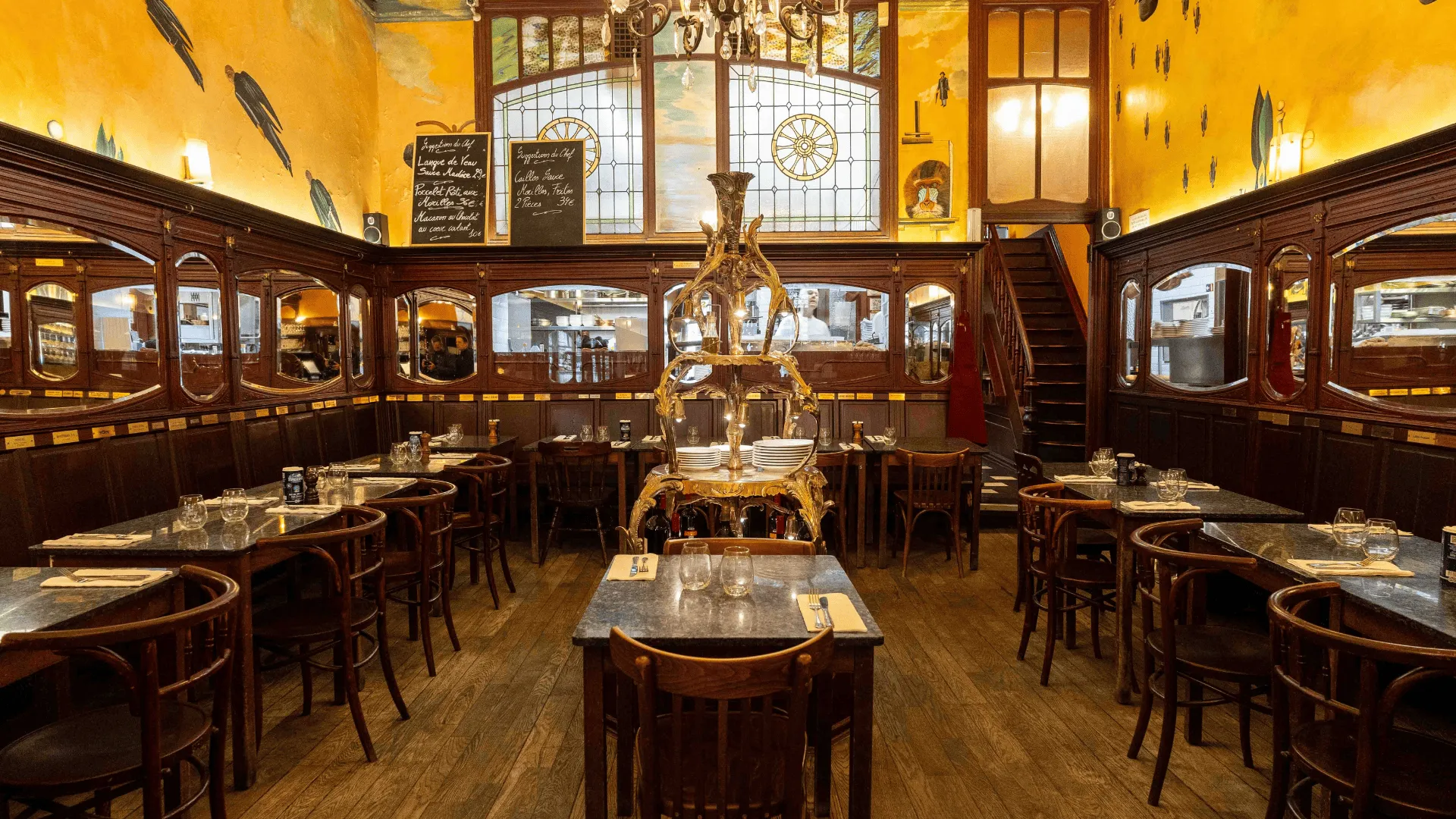
If you are looking for a classic Brussels brasserie with genuine character, La Roue d’Or on the Rue des Chapeliers is the answer. Dark wood, high ceilings covered in frescoes, marble-topped tables and walls lined with Magritte-inspired murals, you are unmistakably in Brussels.
Rated in the top 1% of restaurants in the city by Tripexpert, cited by Frommer’s, Fodor’s and the Michelin Guide, La Roue d’Or has earned its reputation through decades of consistent, faultlessly friendly service and honest Belgian cooking. The moules are a benchmark. The steak-frites won’t disappoint. The beer selection is exactly what you would hope for.
The restaurant is a short walk from both hotels, your team at the front desk can point you in the right direction.
For a special dinner: Au Vieux Saint Martin, on the Sablon
For an evening that goes slightly beyond the neighbourhood brasserie, we recommend making the ten-minute walk to the Place du Grand Sablon and dining at Au Vieux Saint Martin. The Franco-Belgian bistro at number 38 on the square holds a Michelin Plate recognition in both 2024 and 2025, a quiet distinction that signals consistent kitchen quality without the ceremony or prices of Brussels’ fine-dining tables.
The square itself is reason enough to make the trip at dusk, particularly now that new boutiques are transforming the Sablon into one of Europe’s most interesting luxury addresses, as we wrote in our recent guide to the Sablon’s transformation. The combination of a long dinner on the terrace, a post-dinner walk around the church and a leisurely stroll back through the city centre makes for a perfect Brussels evening.
Open seven days a week, booking is recommended for dinner.
A few tips from our team:
- Avoid eating directly on the Grand-Place itself: the view is magnificent, but prices are high and quality is inconsistent. Walk one or two streets away and the experience improves immediately.
- Ask us our front desk team at both hotels knows the neighbourhood well and can recommend based on what you are in the mood for: Belgian classics, a quiet corner table, a lively brasserie, or something more refined.
- Book ahead for dinner: central Brussels fills up on Thursday, Friday and Saturday evenings. A quick call or online booking saves time.
For more inspiration on what to see and do while you are here, our Discover Brussels guide covers the city’s finest landmarks, all within walking distance of the hotel.
Planning a weekend in Brussels and wondering how to make the most of 48 hours in Brussels? You are in the right place. As hosts at Alma and Aris Grand-Place, both a two-minute walk from the Grand-Place, we know this city on foot, by neighbourhood, by season. Here is the itinerary we would give a friend.
Day 1: the historic heart, entirely on foot
Morning: Grand-Place, Galeries Saint-Hubert and Manneken Pis
Start where Brussels starts. The Grand-Place, UNESCO World Heritage Site since 1998 is at its best before 9am, when the cobblestones are quiet and the light catches the gilded guild house facades. Walk the perimeter unhurriedly. The Town Hall dates to 1402. The King’s House opposite houses the Brussels City Museum, including over 900 costumes made for Manneken Pis over the centuries.
From the Grand-Place, step into the Galeries Royales Saint-Hubert, one minute from Aris Grand-Place, two from Alma hotel for breakfast and the city’s finest pralines at Neuhaus. The covered arcade, built in 1847, predates Milan’s Galleria Vittorio Emanuele II. It rewards a slow morning walk.
Continue south to the Manneken Pis: five minutes on foot, smaller than expected, more charming than any photograph. Our guide to the best chocolate shops in Brussels covers the other stops worth making along this morning route.
Afternoon: Mont des Arts and the Royal Museums of Fine Arts
Walk ten minutes south to the Mont des Arts, a formal terraced garden offering one of the finest views of the Brussels skyline. It is a natural pause before the afternoon’s museums.
The Royal Museums of Fine Arts of Belgium on rue de la Régence bring together the Old Masters Museum, the Museum of Modern Art and, separately ticketed within the same complex, the Magritte Museum, the world’s largest collection of the Belgian surrealist’s work. Allow two hours minimum. Book online, weekends sell out.
Evening: The Sablon and dinner
End Day 1 at the Place du Grand Sablon, ten minutes from the hotel. The antiques shops, the church, the new boutiques that have recently arrived as part of the neighbourhood’s transformation. Dinner at Au Vieux Saint Martin at number 38 on the square: Michelin Plate 2024 and 2025, open seven days a week. Reserve ahead for weekends.
Day 2: Art Nouveau and Brussels beyond the centre
Morning: Atomium and Mini-Europe
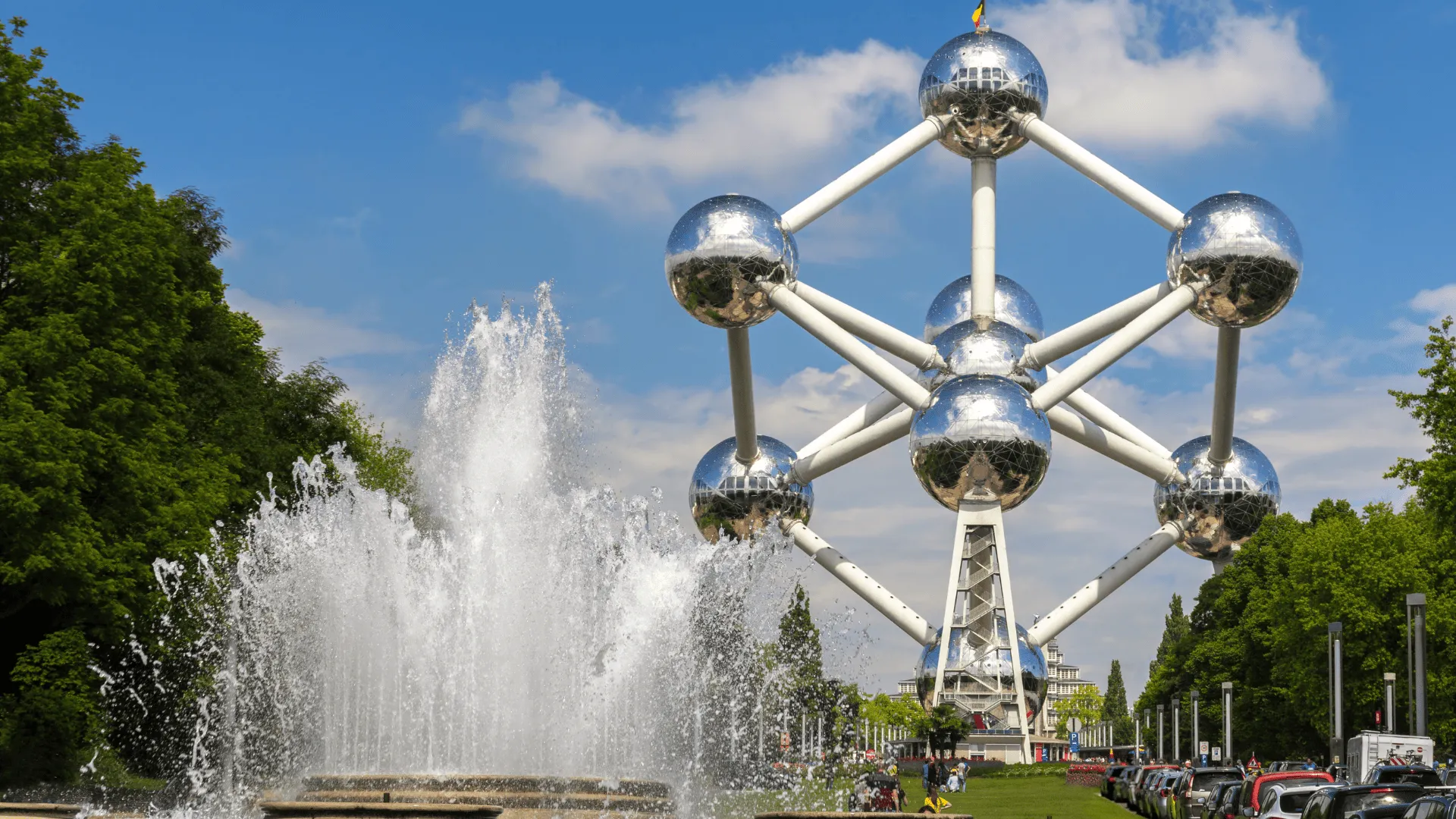
Day two requires a tram. The Atomium, nine connected steel spheres built for the 1958 World’s Fair, is 30 minutes from the city centre on tram lines 7 or 51. The panoramic view from the top sphere and the permanent exhibition on the 1958 Expo are the highlights. Mini-Europe next door offers a genuinely enjoyable hour, scaled-down landmarks from across the continent, including a working model of the Channel Tunnel. Arrive early: both sites fill up on weekend mornings.
Afternoon: The Horta Museum and Art Nouveau Brussels
Return to the city for lunch, then head to Saint-Gilles for the Horta Museum, the former home and studio of Victor Horta, the architect who defined Art Nouveau. The building is a masterpiece of light, ironwork and organic detail. Book in advance; visitor numbers are strictly limited.
The walk back towards the city centre passes through rue Defacqz, rue Faider and rue Paul Emile Janson, some of Brussels’ finest residential Art Nouveau streets. No guide needed: the facades speak for themselves.
Evening: Belgian beer, the right way
A Brussels weekend is not complete without time in a genuine beer café. Delirium Café near the Grand-Place holds the Guinness World Record for the largest beer menu. For something quieter and more local, À la Mort Subite on rue Montagne aux Herbes Potagères is the address our front desk team recommends most often.
Where to stay for your weekend in Brussels
Both Alma Grand-Place and Aris Grand-Place place you at the starting point of Day 1 from the moment you arrive. For booking questions, breakfast times and transport tips, our FAQs page has the answers.
Deciding where to stay in Brussels for the Christmas market is not a minor detail, it shapes the entire experience. When the sound and light show at the Grand-Place runs from 5pm to 10pm every evening, being two minutes from the square rather than twenty makes the difference between stepping out spontaneously on a Tuesday evening and planning a trip. Between watching the show twice in one stay and seeing it once. Between returning to your room at 10pm on foot and queuing for a taxi in the cold.
This article explains why location matters for a Christmas break in Brussels, and what to look for in a hotel before you book.
Why your hotel location defines your Christmas break in Brussels
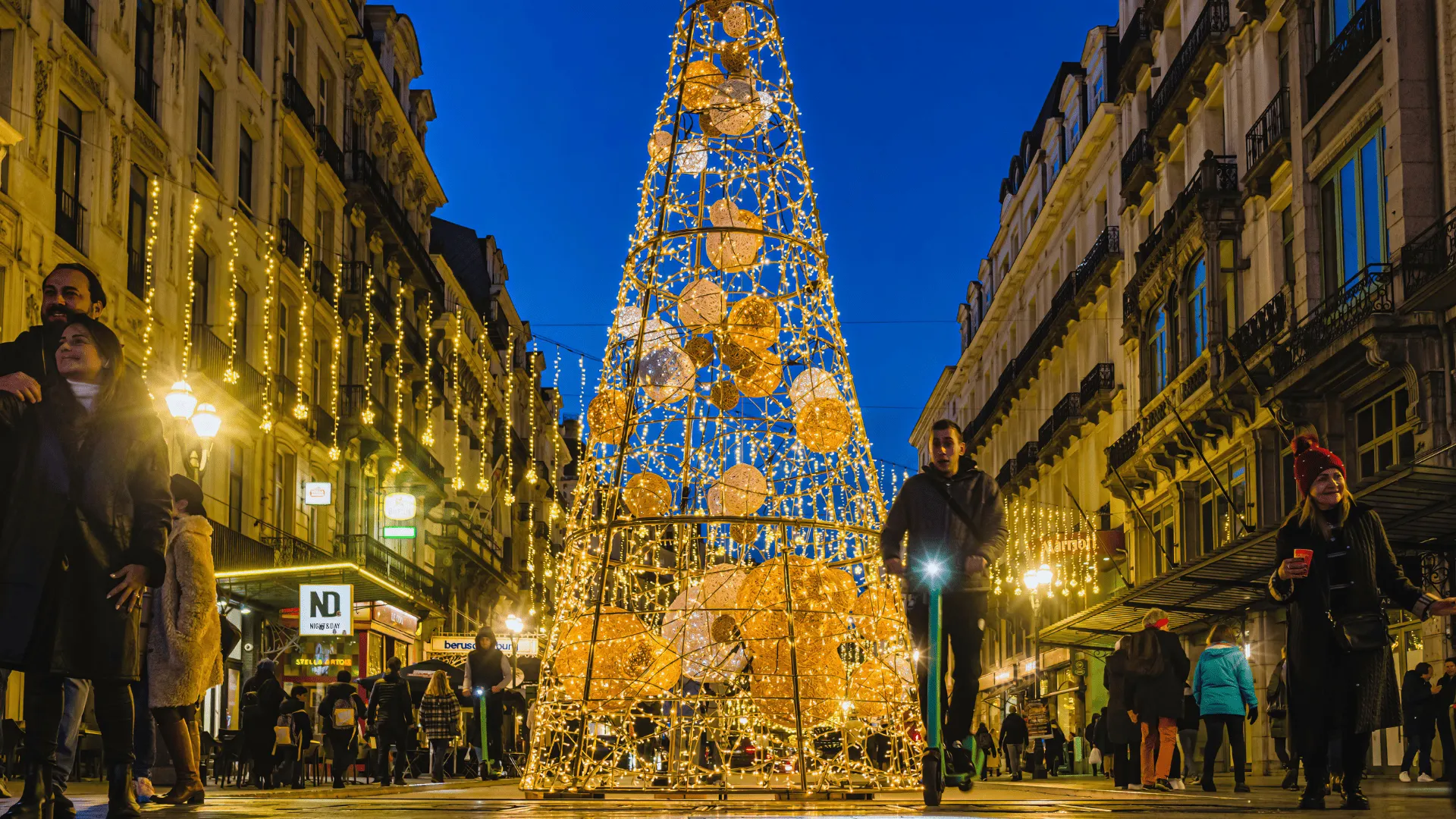
Winter Wonders stretches across nine squares connected by a 2.5-kilometre trail of lights. The Grand-Place is the centrepiece, home to the Christmas tree and the 360° sound and light show that draws the largest crowds. Place Sainte-Catherine hosts the main market with 200+ chalets, the Ferris wheel and the merry-go-round. Place de Brouckère has the ice rink. Rue de la Madeleine has artisan stalls that most visitors miss entirely.
All of these are walkable from the city centre. But walkable covers a range, from two minutes to twenty-five, depending on where you are staying. On a cold December evening, after a day of market browsing, mulled wine and waffles, that difference is significant.
The area between the Grand-Place and Place Sainte-Catherine, bounded by rue des Éperonniers, rue du Marché aux Herbes and the Galeries Royales Saint-Hubert, is the most central position you can occupy for Winter Wonders. You are at the intersection of the festival’s two main hubs, and the illuminated trail passes your door.
The hotel Grand-Place Brussels Christmas advantage
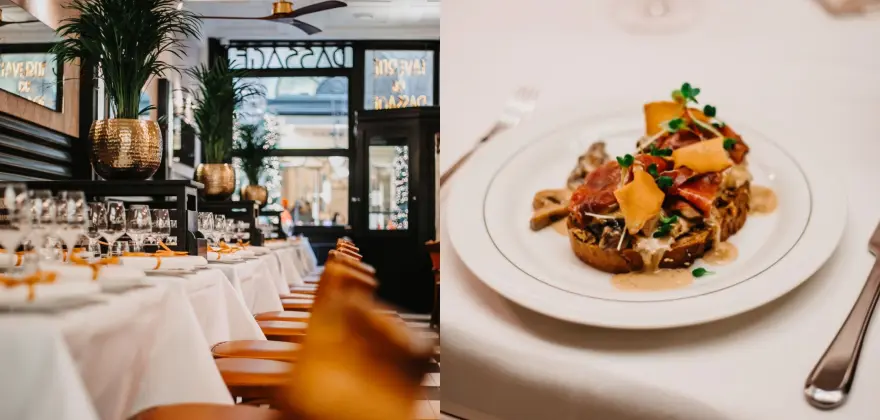
Alma Grand-Place is a quiet side street opening directly onto the Grand-Place area. The sound and light show is a two-minute walk. The Galeries Royales Saint-Hubert are around the corner. On market evenings, guests return to their rooms, warm up, and go back out. The hotel’s 24-hour reception means no rush, no curfew, no constraints.
Aris Grand-Place is positioned between the Grand-Place and the Galeries Saint-Hubert, and equally close to Place Sainte-Catherine where the main market chalets are concentrated. For guests who want to spend evenings at the market rather than travelling to it, this is the address.
Choosing your room for a Christmas stay
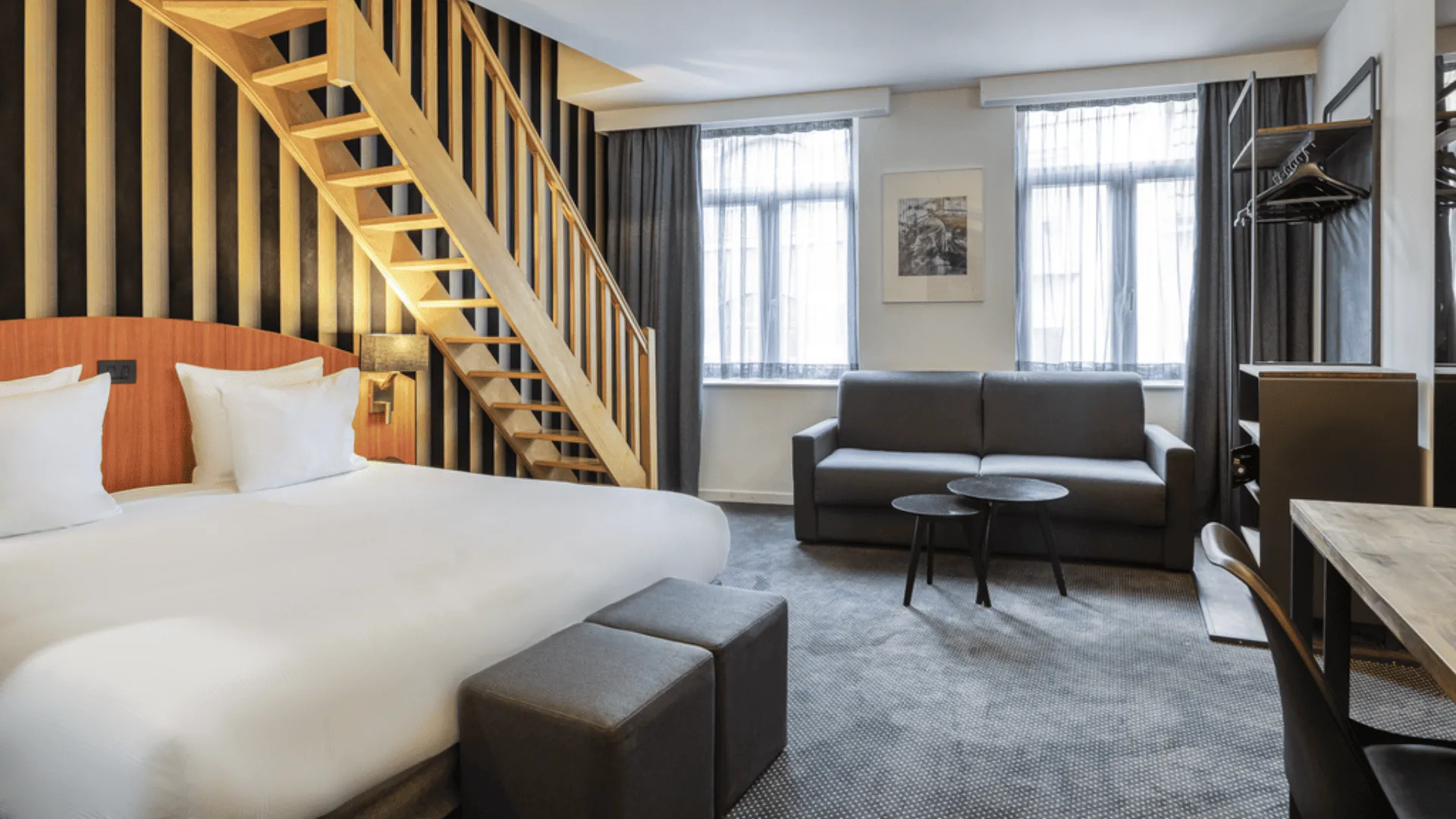
For couples planning a Christmas break in Brussels, the Premium King Room at Alma hotel, part of the Brussels Romantic Gourmet Break package, combines the most elegant room in the hotel with Belgian chocolates, wine and an exclusive Club discount.
For families, the Family Duplex at both hotels sleeps up to five people across two bedrooms and two bathrooms. The CLUB Family Offer, available exclusively when booking direct, includes goodies for children.
For solo travellers or those on a shorter city break, Aris hotel offers the only single room option in the Arbany Hotels group and one of the most competitively priced positions in the city centre for the Christmas period.
Book direct: why it matters during the Christmas season
December is Brussels’ busiest hotel period. Availability at centrally located properties fills up weeks in advance, and OTA platforms add booking fees that inflate the final price without adding any value.
Booking directly on the Arbany Hotels website guarantees the best available rate with no intermediary fees, access to exclusive packages not available elsewhere, and free membership of Club Arbany Hotels, the loyalty program that accumulates benefits from your very first night.
Members who book direct also benefit from flexible modification conditions, useful during the winter period when travel plans are more susceptible to weather or transport disruptions.
Our complete guide to the Brussels Christmas Market 2026 covers all locations, highlights and practical information for Winter Wonders.
Brussels in December is one of Europe’s most underestimated winter destinations. The city does not have Prague’s fairytale skyline or Vienna’s imperial Christmas markets, but it has the Grand-Place, one of the most beautiful squares on the continent, illuminated nightly with a 360° sound and light show that draws three million visitors a year. It has Belgian chocolate, 1,500 varieties of beer, warm taverns built for exactly this season, and a train network that makes Bruges, Ghent and Antwerp all reachable as day trips.
Here are the things to do in Brussels in December that go beyond the obvious, with the obvious included, because some of it is genuinely unmissable.
Brussels December activities, starting with Winter Wonders
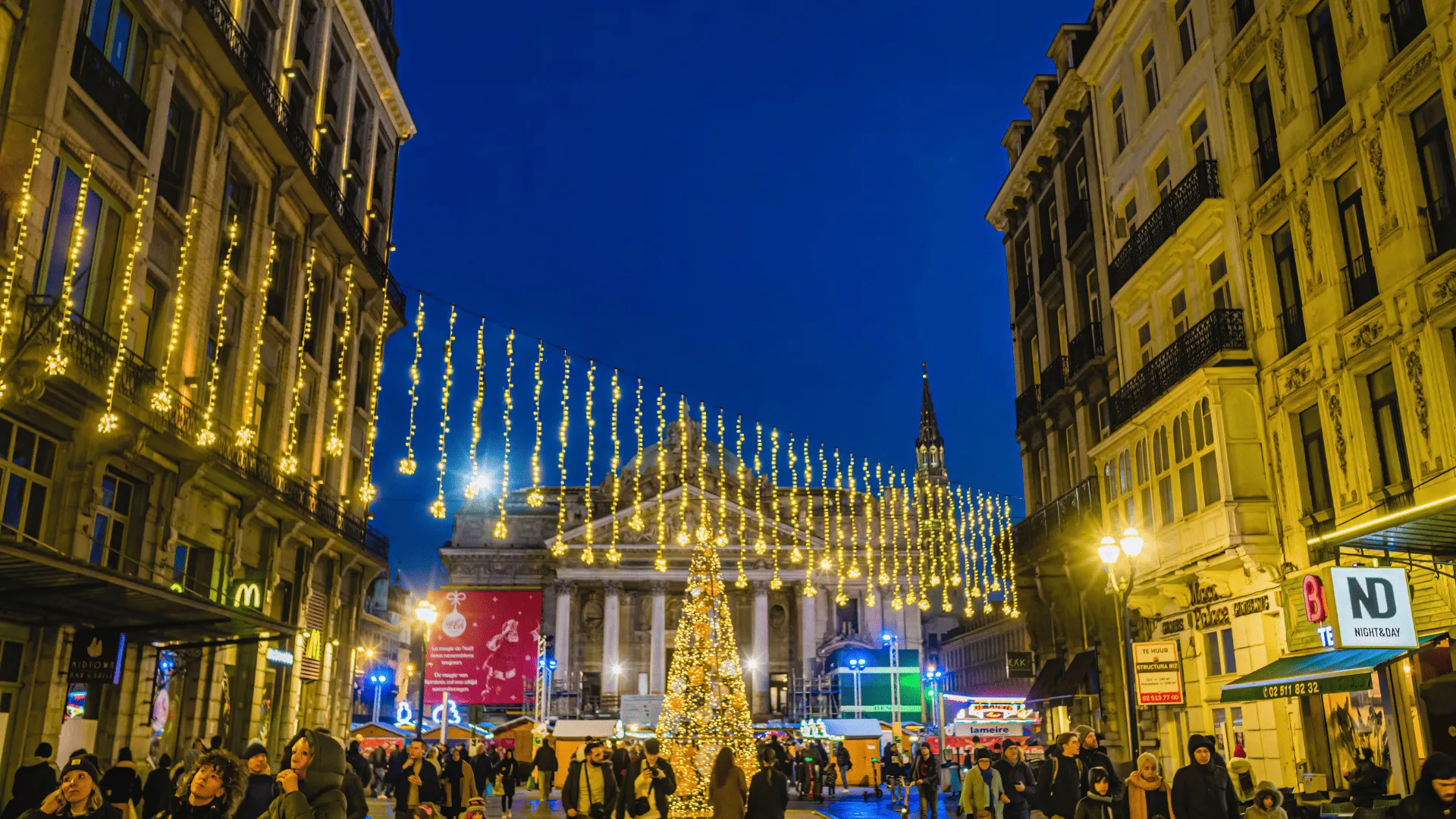
The Christmas market is the undeniable anchor of December in Brussels. Winter Wonders runs from 27 November 2026 to 3 January 2027 across nine squares connected by a 2.5 kilometre illuminated trail. The sound and light show at the Grand-Place runs nightly from 5pm to 10pm and is free. The ice rink at Place de Brouckère operates throughout the festival period.
We covered Winter Wonders in detail in our complete Brussels Christmas Market guide, locations, highlights, what to eat and when to go. Start there if you are planning your visit around the market.
What follows covers everything else December has to offer.
Day trips from Brussels in December: Bruges and Ghent
One of Brussels’ most underused assets in December is its position at the centre of Belgium’s train network. From Brussels Central Station, five minutes on foot from both hotels, you can reach:
Bruges in 1 hour. The medieval city holds its own Christmas market on the Markt and Simon Stevinplein squares, typically running from late November through to early January. The combination of Bruges’ canal architecture and winter light is one of Belgium’s most photographed December experiences. Bruges Christmas market runs alongside the city’s permanent attractions: the Groeningemuseum, the Brewery De Halve Maan and the Basilica of the Holy Blood. A full day return is entirely comfortable.
Ghent in 30 minutes. Ghent’s Christmas market in 2026 runs from 5 to 31 December in the city centre St Bavo’s Cathedral, Sint-Baafsplein and the Korenmarkt. Ghent is architecturally richer than most visitors expect, and the medieval Gravensteen castle lit in December is not easily forgotten. The Ghent market is considerably less crowded than Brussels and rewards a half-day visit.
Both cities are served by direct trains from Brussels Central. Eurostar also connects Brussels to London in under two hours, useful context for guests travelling from the UK.
Brussels in December indoors: museums worth the cold
December is the ideal month to revisit Brussels’ museums without the summer queues. Three addresses worth prioritising:
The Magritte Museum at rue de la Régence 3, ten minutes from the hotels holds over 200 works by the Belgian surrealist. In December, the museum extends its evening opening hours on selected dates, allowing visits after the Christmas market closes for the afternoon. Book online at musee-magritte-museum.be.
The Musical Instruments Museum (MIM) at rue Montagne de la Cour 2 is open Tuesday to Sunday from 9:30am. The rooftop café offers one of the best views of Brussels, considerably more dramatic in December with the city lit below. Entry is €15 for adults, free for under-18s.
The Belgian Comic Strip Centre at rue des Sables 20, 12 minutes from the hotels, runs its permanent exhibitions year-round and is particularly suited to a rainy December afternoon. The building itself, a Victor Horta Art Nouveau warehouse, is worth the visit independently of the collection.
Belgian beer in winter: the tavern experience
December in Brussels calls for a specific kind of evening: a small tavern, a Trappist ale, warmth. The Belgian beer culture, UNESCO Intangible Cultural Heritage since 2016, produces seasonal winter beers that are only available from November to January, typically darker, stronger and spiced with herbs or orange peel.
Three addresses for the tavern experience in the city centre:
À la Mort Subite at rue Montagne aux Herbes Potagères is Brussels’ reference address for lambic and gueuze, the spontaneously fermented beers unique to the Brussels region. The Art Nouveau interior, unchanged since 1928, is itself a reason to visit.
Delirium Café near the Grand-Place holds the Guinness World Record for the largest beer menu (over 3,000 references). In December, the covered terrace runs heat lamps and the seasonal Belgian winter ales are prominently featured.
Bier Circus at rue de l’Enseignement 89 is the address for guests who want to be guided through the Belgian beer landscape by knowledgeable staff. The menu includes tasting notes and food pairing suggestions. Quieter than Delirium, considerably more instructive.
Wonder Woods: the Bois de la Cambre in December
For guests with children or anyone who wants to experience a festive Brussels beyond the city centre, Wonder Woods at the Bois de la Cambre runs from early December through early January. The park is transformed with light installations, music, an outdoor ice rink, the Chalet Robinson restaurant on its island, and a programme of family activities at weekends.
Getting there requires a tram from the city centre (approximately 20 minutes). It is a different December experience from Winter Wonders quieter, more local, less crowded and considerably more appreciated by Brussels residents than by tourists, which is a reliable indicator of quality.
For guests staying with us over the festive period, our offers include packages designed for December stays, romantic breaks, family configurations and exclusive direct-booking rates.
Brussels’ luxury scene is spread across several distinct neighborhoods, each with its own character and pace, and half the fun lies in exploring this layout. This isn’t a city where everything happens on a single famous street. It’s a city that rewards those who know where to look.
Here’s our guide to luxury shopping in Brussels, neighborhood by neighborhood.
Brussels’ best shopping districts, start at the Galeries Royales Saint-Hubert
Before any boutique, there is the building. The Galeries Royales Saint-Hubert opened in 1847 predating the Galleria Vittorio Emanuele II in Milan by two decades and remain one of Europe’s finest covered arcades. The glazed arched roof, the ornate iron work, the rhythm of shop fronts along a central promenade: it is architecture as an argument for shopping as a civilised act.
The Galeries are a one-minute walk from Aris Grand-Place, and two minutes from Alma hotel. Inside: Neuhaus, inventor of the Belgian praline and still one of its finest practitioners. Delvaux, Brussels’ own luxury leather goods house, founded in 1829 and now one of the most coveted bag brands in the world. And Yvan’s, the family jewellery and watchmaking house that has been Belgium’s reference point for fine horology since 1955.
Start here. Every luxury shopping day in Brussels should begin in the Galeries.
Boulevard de Waterloo: the grand international mile
Running south from Porte Louise, the Boulevard de Waterloo is Brussels’ most concentrated luxury retail strip, the closest equivalent to a traditional grands magasins district. Gucci, Louis Vuitton, Dior, Chanel, Cartier and Ralph Lauren line the boulevard in succession. Hermès is at number 50. Carine Gilson, the Belgian lingerie designer whose work sits in the wardrobes of some of the most discerning women in Europe, has her flagship here.
The boulevard rewards a slow afternoon walk rather than a targeted visit. The architecture is consistently handsome, the display windows are well curated, and the cafés between boutiques provide natural pauses. If you have one afternoon for serious luxury retail in Brussels, this is where to spend it.
Avenue Louise: fashion, design and Belgian names
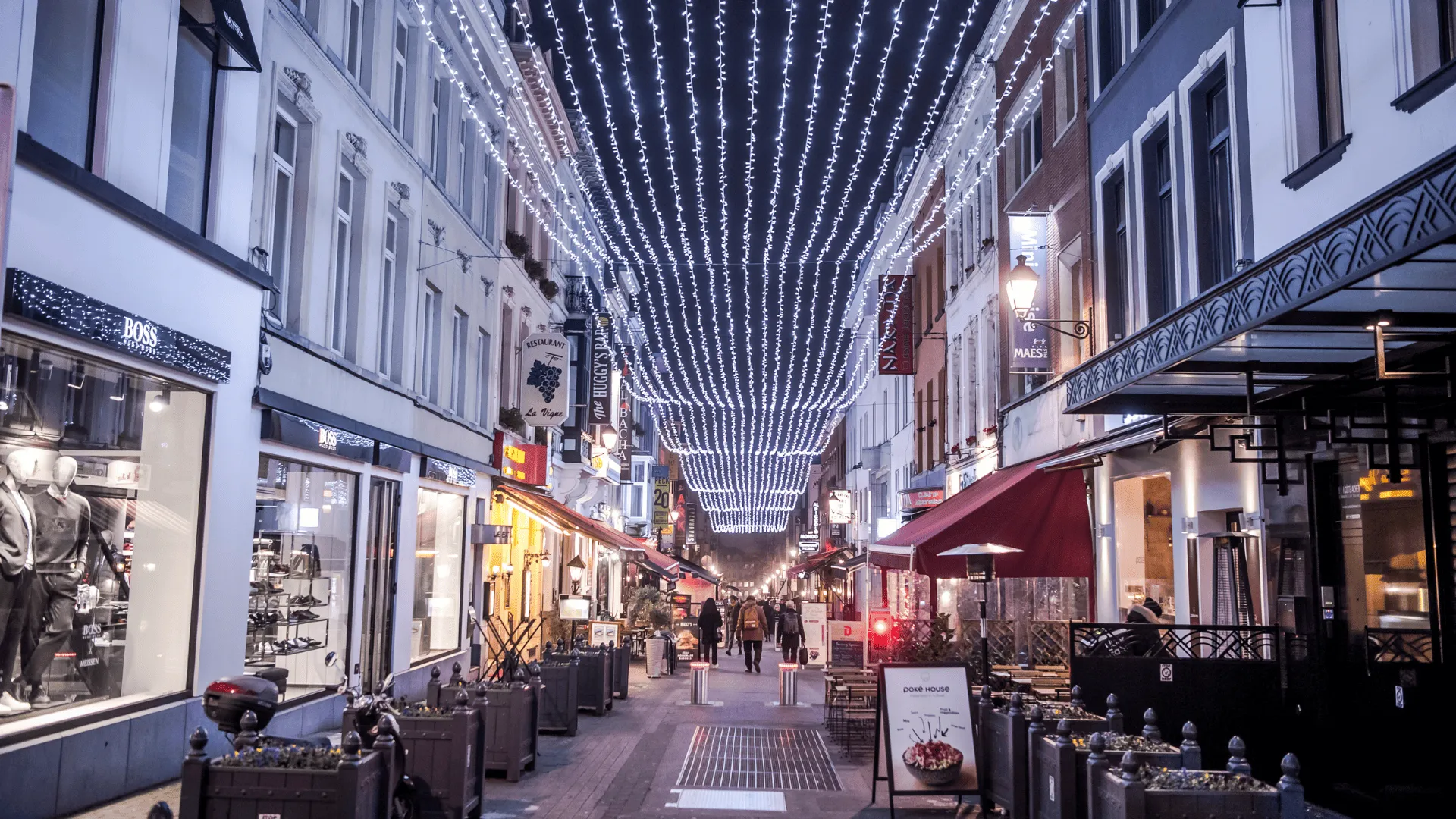
Avenue Louise extends from the Boulevard de Waterloo further south, and shifts the register slightly. Alongside the international names, Max Mara, Montblanc, Michael Kors, the avenue and its immediate side streets are where Brussels’ own designers and independent boutiques concentrate.
Belgian fashion has a genuine voice: architectural, precise, occasionally eccentric. The names associated with the Antwerp Six are known internationally, but Avenue Louise’s independent boutiques are where local design talent is most consistently represented. Browse the side streets of the avenue as much as the avenue itself, the discoveries are usually there rather than on the main strip.
The Sablon: the neighbourhood having its moment
The Place du Grand Sablon has always been Brussels’ most atmospheric luxury address. Antique dealers, art galleries, Pierre Marcolini’s chocolate, Taschen’s art books, the foundations were already there. What has changed recently is the arrival of major fashion and jewellery houses: AMI Paris, Breitling, Christian Louboutin, with Hermès expected to follow.
We wrote at length about this transformation, the new boutiques, the Immobel development project and what it means for the neighbourhood in our guide to the Sablon. If the Sablon is your primary destination, start there.
Delvaux Brussels: the luxury address that is entirely Belgian
Any guide to luxury shopping in Brussels is incomplete without pausing on Delvaux. Founded in Brussels in 1829, Delvaux is the world’s oldest fine leather goods house, predating Louis Vuitton by 25 years. The Brillant bag, introduced in 1958, remains the house’s signature. The craftsmanship is entirely Belgian. The waiting lists are entirely international.
Delvaux has multiple locations in Brussels, including in the Galeries Royales Saint-Hubert. It is one of those rare cases where the locally made thing is also the globally coveted thing a combination Brussels does not always make obvious, but Delvaux makes impossible to ignore.
Planning your shopping day
The Galeries Royales Saint-Hubert, the Sablon and the Grand-Place area are all walkable from our hotels, a morning circuit of 90 minutes covers all three comfortably. Boulevard de Waterloo and Avenue Louise are a 20-minute walk south, or two stops by tram from the city centre.
Our Discover Brussels guide has the full map of what is reachable on foot. And for a stay built around a shopping visit, with the right room, the right timing and direct booking rates our offers & Experiences page is the place to start.
Today Brussels has more chocolate shops per square kilometre than anywhere else in Europe. The question is never whether to buy chocolate, it is where. Here is our guide to the best chocolate shops in Brussels, all located just a few minutes’ walk from the hotel.
Neuhaus: where Belgian chocolate in Brussels began
Galerie de la Reine 5, Galeries Royales Saint-Hubert
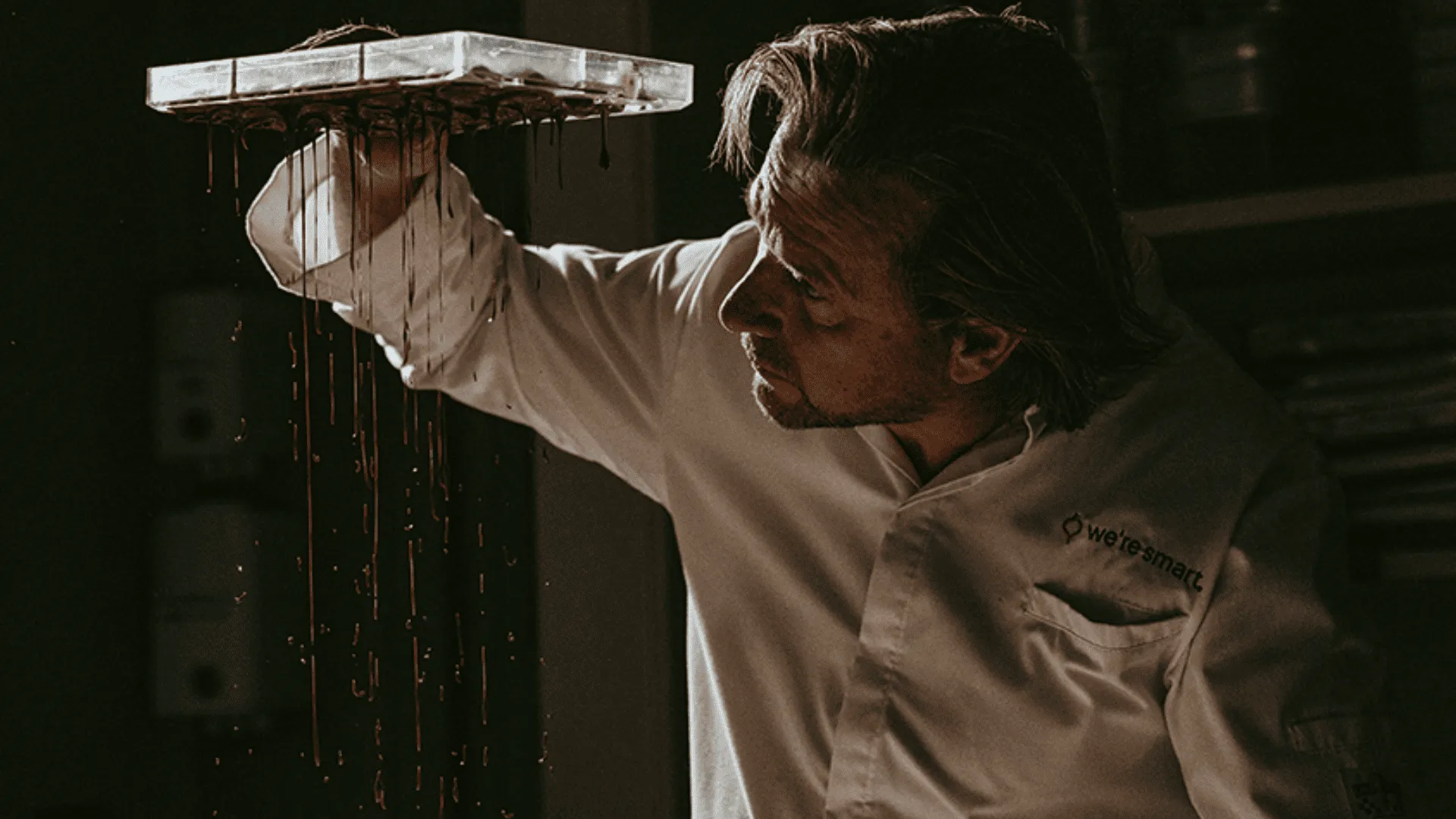
You can walk to Neuhaus from Aris Grand-Place in under two minutes. The house that invented the praline in 1912 is still producing it in the same Galeries where Jean Neuhaus worked. The ballotins, those distinctive gold boxes remain the standard against which all other Belgian chocolate packaging is measured.
The pralines are classic, precise and immediately recognisable. If you are buying a gift to take home, Neuhaus is the instinctive choice. If you are buying for yourself, allow the staff to guide you through the seasonal selection.
Wittamer: the finest pralines in Brussels, on the Sablon since 1910
Place du Grand Sablon 6 & 12
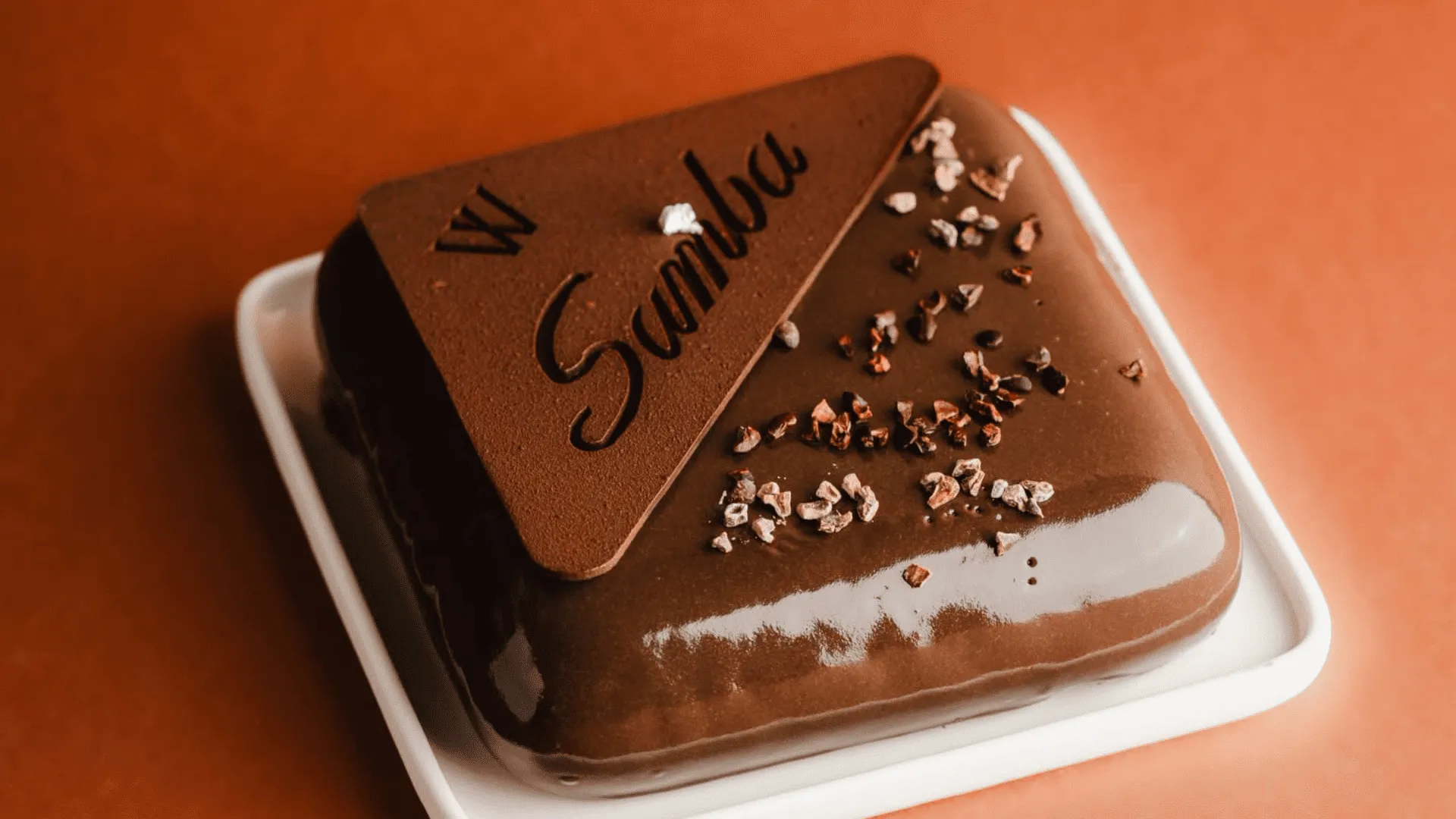
Wittamer has occupied its corner of the Place du Grand Sablon since 1910, and holds the title of Official Supplier to the Court of Belgium. The pralines are superb, the raspberry hearts are a particular point of loyalty among regulars. But the real case for Wittamer is its café on the upper floor: on a cold October afternoon, the hot chocolate served there is, without exaggeration, one of the best things you will eat or drink in Brussels.
A 10-minute walk from the hotels through the historic centre. Combine with the Saturday antiques market on the square, as we described in our guide to the Sablon.
Pierre Marcolini: chocolate as craft
Rue des Minimes 1, near the Sablon
Pierre Marcolini is Brussels’ most internationally recognised chocolatier, and the one most likely to prompt the question: is chocolate a luxury good? At Marcolini, the answer is yes and it is justified by the quality of the sourcing. Single-origin cocoa, direct relationships with plantation partners, no child labour, no glyphosate. The pralines are displayed like jewellery. The shop is designed like a boutique.
The grand cru bars are the best entry point for a first visit. The seasonal collections, which change throughout the year are worth following.
Laurent Gerbaud: the unconventional choice
Stoofstraat 19 / Rue de l’Étuve, near Grand-Place
Laurent Gerbaud won Chocolatier of the Year in 2021, and represents a different school of Belgian chocolate entirely. His creations are less sweet than the classic praline tradition, and his flavours reflect years of travelling: yuzu, matcha, fig and thyme, candied ginger. He works from a small shop, close enough to Grand-Place to visit before or after a walk around the square where you can sometimes hear the chocolate being made in the back.
If you are looking for something genuinely unusual to bring home, or something to eat on the spot, Gerbaud is the address.
Galler: approachable and just steps from Grand-Place
Rue au Beurre 44
Galler is the most accessible address on this list, in location and in price. The shop on Rue au Beurre is a two-minute walk from Alma hotel and three from Aris hotel. The chocolate bars, in their colourful wrappers and playful flavour combinations, are designed to be eaten immediately rather than given as gifts, dark chocolate with sea salt, milk chocolate with speculoos, white chocolate with raspberry. Buy one on your way back to the hotel.
One rule before you go
The Grand-Place and its immediate surroundings are lined with chocolate shops selling moulded Manneken Pis figurines and multicoloured pralines at tourist prices. They look appealing. They are not the same thing as what is listed above.
The difference between a tourist chocolate shop and a Belgian chocolatier is roughly the same as the difference between a souvenir baguette and a bakery. Both exist. Only one is worth your time.
Our Discover Brussels guide maps all of these addresses and everything else worth finding on foot from the hotel.
The best restaurants in Brussels for a winter evening share a few qualities: warmth in the literal sense, a kitchen that understands what Belgian cuisine is actually capable of, and a room where you are happy to sit for two hours without feeling rushed. Here is our selection, organised by what kind of evening you are looking for.
For a legendary Brussels table: Bozar and Comme Chez Soi
Two restaurants define Brussels at its most ambitious, and both are worth planning a trip around.
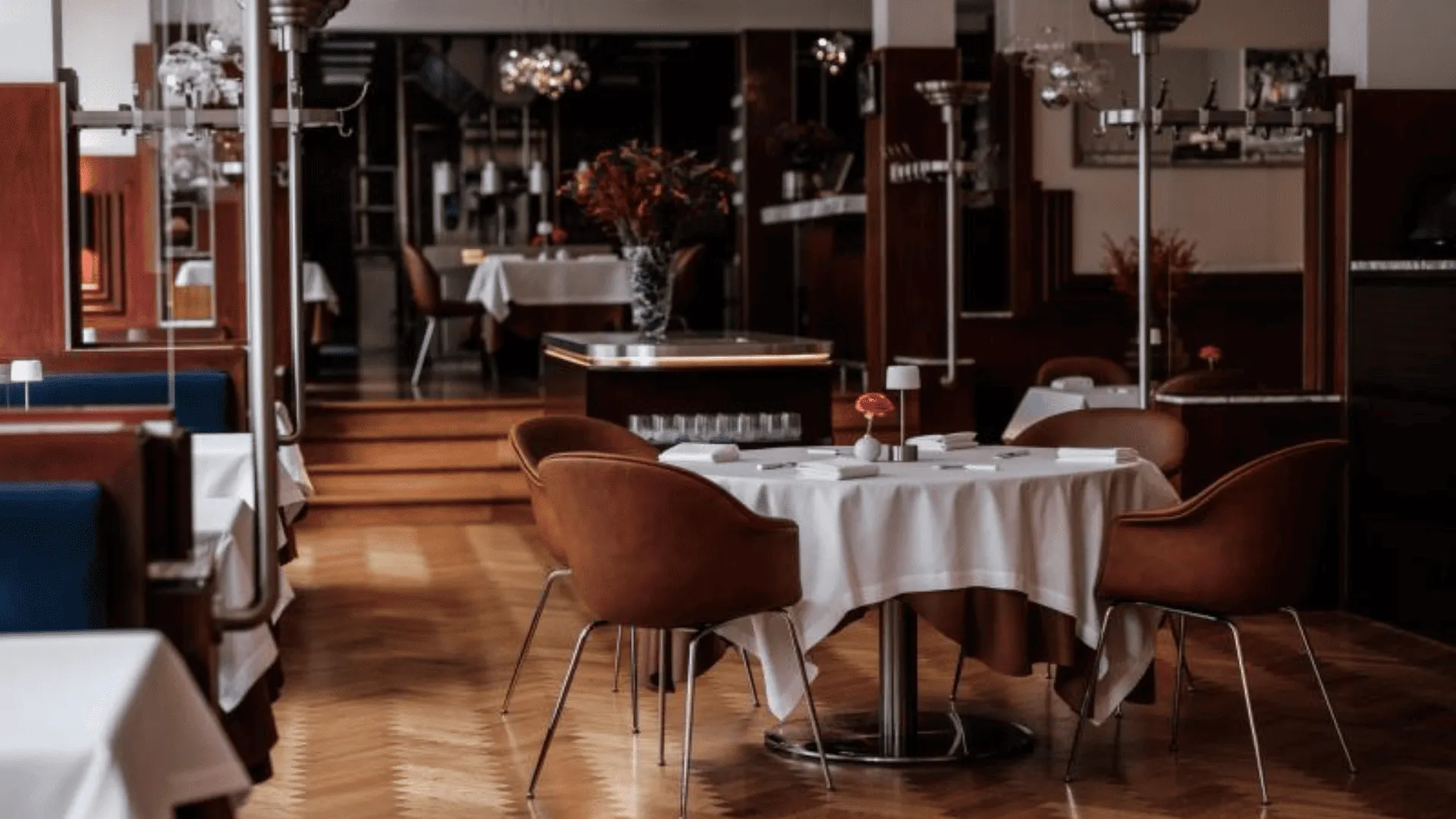
Bozar Restaurant at Rue Baron Horta 3 is the only Brussels restaurant ranked in the World’s 50 Best Restaurants list (number 63 in 2025) and holds an OAD ranking of 11 globally. Chef Karen Torosyan’s cooking is built around exceptional technique, the pâté en croûte and pithiviers are dishes that have generated genuine critical attention internationally. The setting, inside the Centre for Fine Arts designed by Victor Horta, adds an architectural dimension that most restaurant rooms in Europe cannot match. Book weeks in advance for dinner. The lunch menu offers a more accessible entry point.
Comme Chez Soi at Place Rouppe 23 is one of Brussels’ most storied tables a Michelin-starred institution that has been serving refined French-Belgian cuisine since 1926. The Art Nouveau dining room, designed by Horta, seats fewer than 50 covers. The cooking is precise, classical and consistently excellent. For a special occasion dinner during a winter stay in Brussels, this is the address that local food professionals recommend most often.
For authentic Belgian cuisine in Brussels, winter comfort done properly
Winter in Brussels calls for carbonnade, stoemp and rabbit cooked in kriek. These dishes hearty, beer-based, built for cold weather are the reason Belgian cuisine deserves more international attention than it receives.
Fin de Siècle at Rue des Chartreux 9 in the Saint-Géry quarter is consistently cited as one of the best places in Brussels to eat authentic Belgian cooking. The carbonnade here is among the finest versions in the city. The atmosphere is convivial, the prices are honest (between €18 and €29 per person), and the queue outside on weekend evenings tells you everything you need to know about its local standing. No reservations, arrive early or wait.
Zotte Mouche at Rue de l’Ecuyer 47, a five-minute walk from both hotels offers a 1960s-1980s atmosphere alongside one of Brussels’ most praised carbonnades. The menu is short, seasonal and entirely Belgian. The beer list is serious. The room is genuinely warm in winter, both in temperature and in spirit.
For the best brasseries in Brussels, the Sablon end of the evening
The Sablon neighbourhood, ten minutes on foot from the hotels concentrates some of Brussels’ most reliable dinner addresses. For guests who have spent time in the neighbourhood during the day, as we described in our guide to the Sablon’s transformation, ending the evening there makes natural sense.
Les Brigittines at Place de la Chapelle 5 holds a Michelin selection and an OAD new entry for 2025. The brasserie specialises in Belgian cuisine with a contemporary sensibility, the menu changes with the season, and in winter it leans into the country’s strongest culinary traditions. The setting, near the Chapelle church, is quieter than the main Sablon square and all the better for it.
Au Vieux Saint Martin at Place du Grand Sablon 38, Michelin Plate 2024 and 2025, remains our standing recommendation for a reliable, well-priced dinner on the square itself. We mentioned it in our guide to where to eat near Grand-Place and the recommendation stands for winter evenings: book ahead for weekends, the terrace is heated in November and December.
One rule about booking in December
December fills Brussels restaurants faster than any other month. The combination of Winter Wonders tourism, corporate end-of-year dinners and local festive traditions means that the addresses listed above particularly Bozar, Comme Chez Soi and Les Brigittines can be fully booked two to three weeks in advance on Friday and Saturday evenings.
There are three things most people know about traditional Belgian cuisine before they arrive: chocolate, waffles, and beer. All three are absolutely true, and all three are more complex than they seem. The waffles sold near the Grand-Place aren’t usually what Belgians actually eat. Not all chocolates are created equal. And beer with more than 1,500 varieties and its designation as part of UNESCO’s Intangible Cultural Heritage is worth a whole trip on its own.
Beyond these three famous specialties, Belgian food is built on dishes that most visitors never get to try: gray shrimp croquettes, Flemish beef stew, waterzooi, and stoemp. This guide tells you what to eat in Brussels during your city getaway and how to find the authentic specialties rather than their rough tourist versions.
What to eat in Brussels: the essential dishes
Moules-frites: the national dish
Mussels steamed in white wine with celery, onion, butter and fresh herbs, served in the cast-iron pot they were cooked in, alongside a generous portion of fries and a pot of mayonnaise. This is Belgium’s most internationally recognised dish, and at a good address, it justifies that status entirely. The mussels come from Zeeland in the Netherlands, where the tidal conditions produce a particularly flavoursome shellfish. The fries should be double-fried. The mayonnaise should be house-made. When all three elements are right, moules-frites is one of the most satisfying meals in European cooking.
Carbonnade flamande: Belgium’s other national dish
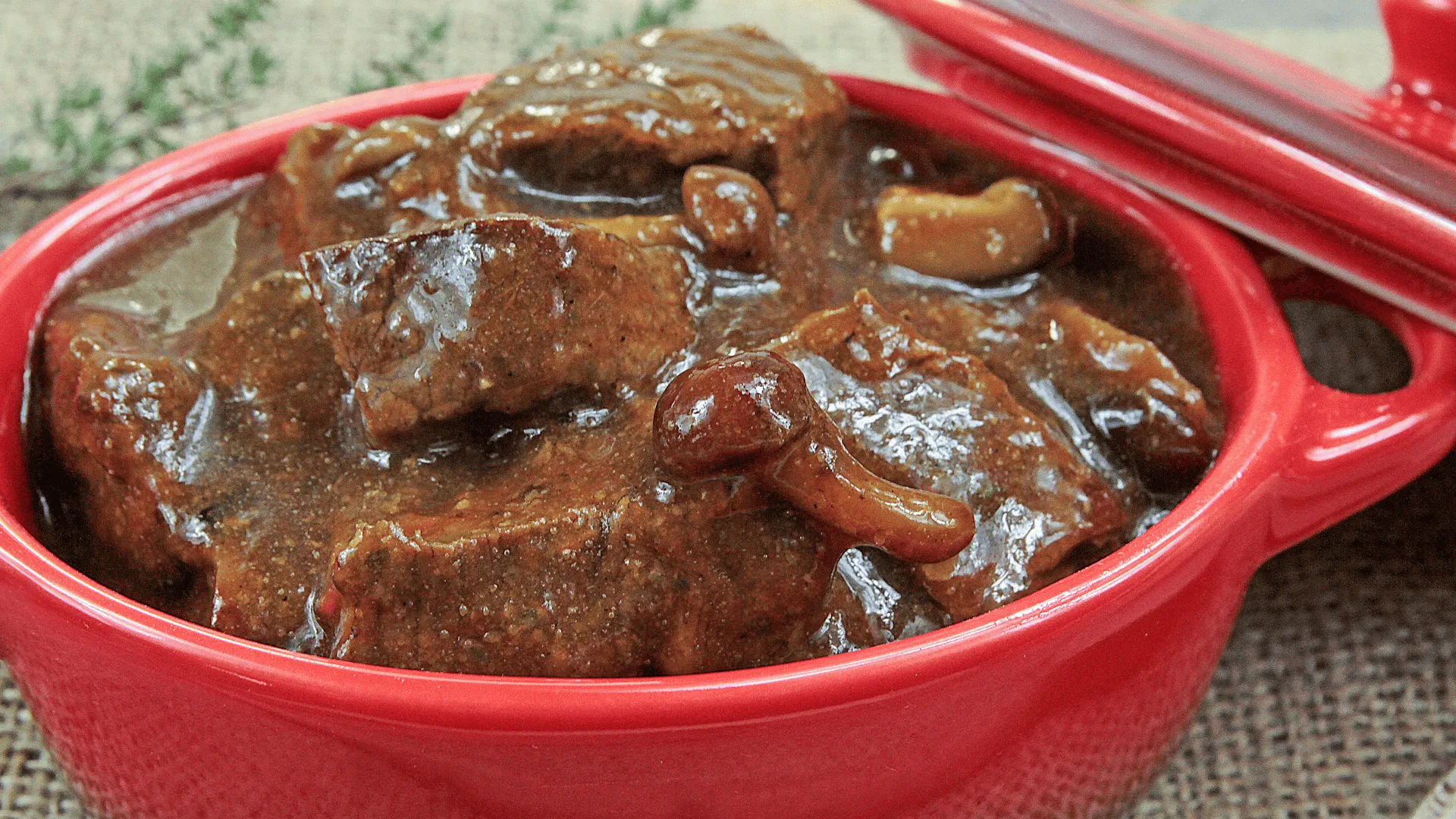
Beef slow-cooked in dark Belgian beer with onions, bread, brown sugar and mustard until the liquid reduces to a dense, complex sauce. Every Belgian household has its own version. Every Belgian brasserie serves one. The key ingredient is the beer, usually a Trappist or abbey ale, which gives the dish a depth that wine-based stews cannot replicate. Served with fries or stoemp, it is the definitive Belgian winter dish.
Croquettes aux crevettes grises: the starter worth ordering
Grey shrimp croquettes are among the most technically demanding dishes in Belgian cooking: a bécha mel sauce densely packed with tiny grey shrimps from the North Sea, coated in breadcrumbs and deep-fried to order. The contrast between the crisp crust and the creamy, intensely flavoured filling is remarkable. Bouillon Bruxelles was awarded Best Shrimp Croquette in Brussels in 2024, a reasonable starting point.
Stoemp: the underrated side dish
Mashed potato combined with a second vegetable leeks, carrots, Brussels sprouts, spinach cooked down until both elements become a single, deeply flavoured purée. Stoemp is the natural companion to sausages, black pudding or a braised rabbit. It is emphatically not elegant. It is emphatically delicious.
Waterzooi: from Ghent, eaten in Brussels
Originally a Ghent dish, waterzooi appears on menus across Brussels in two versions: chicken (poulet à la bruxelloise) or fish, stewed slowly in a broth of vegetables, cream and herbs and served with bread to soak up the liquid. It is subtle, aromatic and entirely unlike anything you will find in French or Dutch cooking. Order the fish version in winter when the chicken version dominates.
Belgian food in Brussels: the things tourists get wrong
The waffle
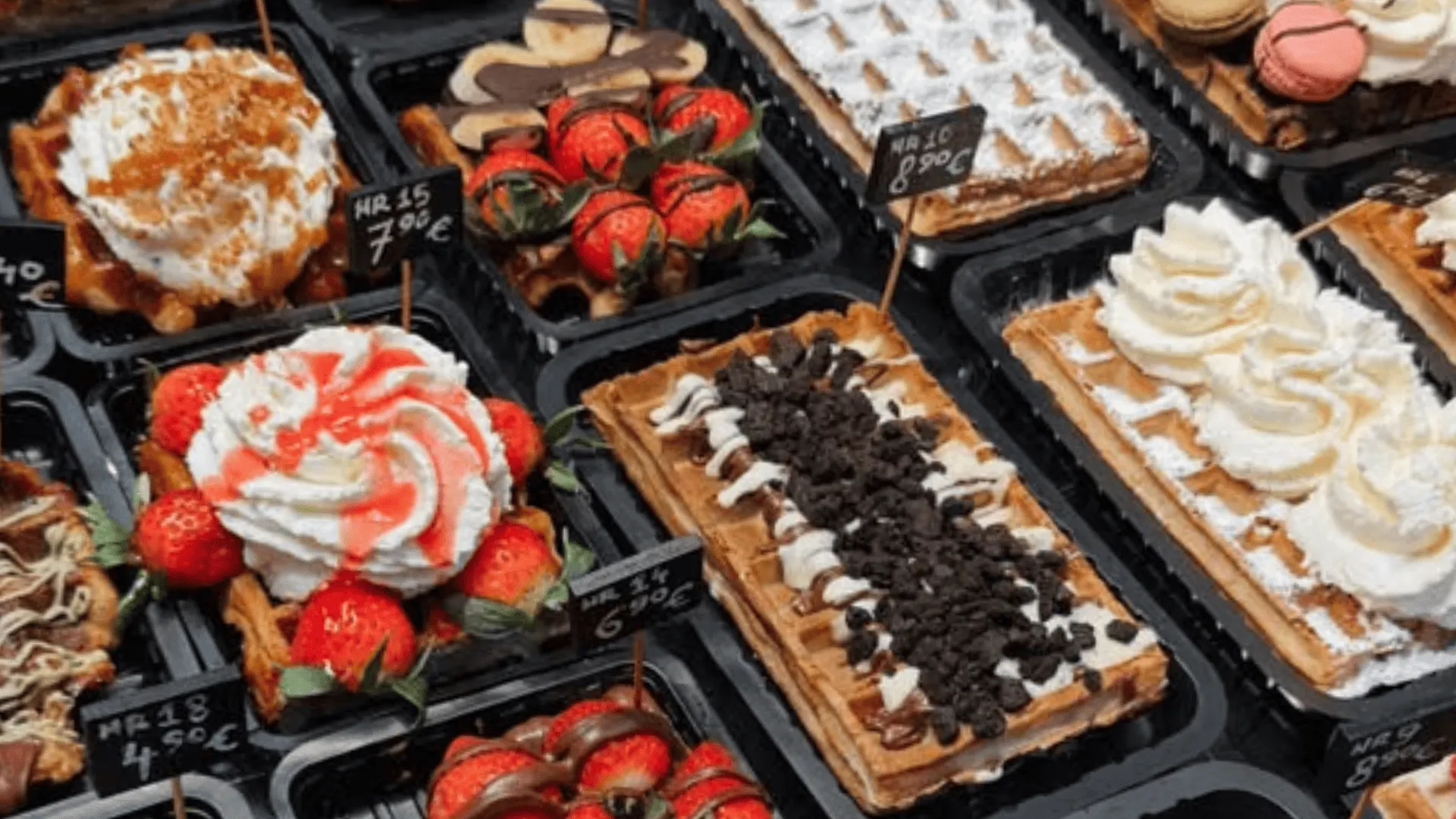
There are two Belgian waffles and they are entirely different things. The Brussels waffle (gaufre de Bruxelles) is rectangular, light, crispy and made with a yeast-based batter, it is typically eaten plain or with a modest topping and is not particularly sweet. The Liège waffle (gaufre de Liège) is round, dense, caramelised with pearl sugar and eaten warm from the stall, it is the one sold at Christmas markets and by street vendors.
The waffles piled high with whipped cream, strawberries and chocolate sauce sold in tourist shops near the Grand-Place are neither. They are a commercial invention aimed at visitors who have not been told the difference. Ask for a gaufre de Liège from a street vendor and eat it within three minutes of purchase. That is the correct experience.
The fries
French fries are Belgian. The word french comes from the old English verb to french, meaning to cut lengthwise, and has nothing to do with France. Belgium’s frites are traditionally cooked twice in animal fat: once at a lower temperature to cook the potato through, then again at a higher temperature to crisp the exterior. The result is categorically different from a single-fried chip. Served with house-made mayonnaise, not ketchup.
The best frites in Brussels city centre are consistently found at dedicated friteries rather than in brasseries. Place Jourdan, slightly east of the centre, is the address locals give most often.
Belgian beer: a brief orientation
Belgium produces over 1,500 varieties of beer. The tradition was inscribed on UNESCO’s Intangible Cultural Heritage list in 2016, the only national beer culture to hold this distinction. The main styles to understand for a Brussels visit:
Trappist ales are brewed by or under the control of Trappist monks, six Belgian abbeys produce them (Chimay, Orval, Rochefort, Westmalle, Westvleteren, Achel). They range from amber to dark brown, with complex malt and fruit characteristics.
Lambic and gueuze are Brussels’ own style: spontaneously fermented using wild yeasts from the Senne valley, unfiltered and slightly sour. Kriek (cherry) and framboise (raspberry) are lambic variants. À la Mort Subite on rue Montagne aux Herbes Potagères is the reference address for lambic in the city centre.
Saison is the farmhouse ale of Wallonia dry, effervescent, slightly spiced. Brasserie Dupont’s Saison Dupont is the benchmark.
For the full picture of where to eat all of the above, our guide to the best restaurants in Brussels for winter covers the addresses that do Belgian cuisine most justice. And for chocolate specifically, our guide to the best chocolate shops in Brussels covers the praline trail from the Galeries Saint-Hubert to the Sablon.
Breakfast at both Alma Grand-Place and Aris Grand-Place is served by Lloyd Coffee Eatery, a Brussels coffee house that understands the city’s food culture from the first cup of the day.
Brussels has over 125 museums. Most visitors see three. Knowing which three or four, or five depends on what you are looking for: world-class fine art, surrealist painting, Art Nouveau architecture, Belgian comic strip culture, or the history of musical instruments housed inside one of the city’s most extraordinary buildings. This guide covers the museums consistently worth what to see in Brussels conversations, with the information you actually need before you go: prices, hours, distances and honest advice on how long to spend in each.
The unmissable Brussels art museum: Royal Museums of Fine Arts of Belgium
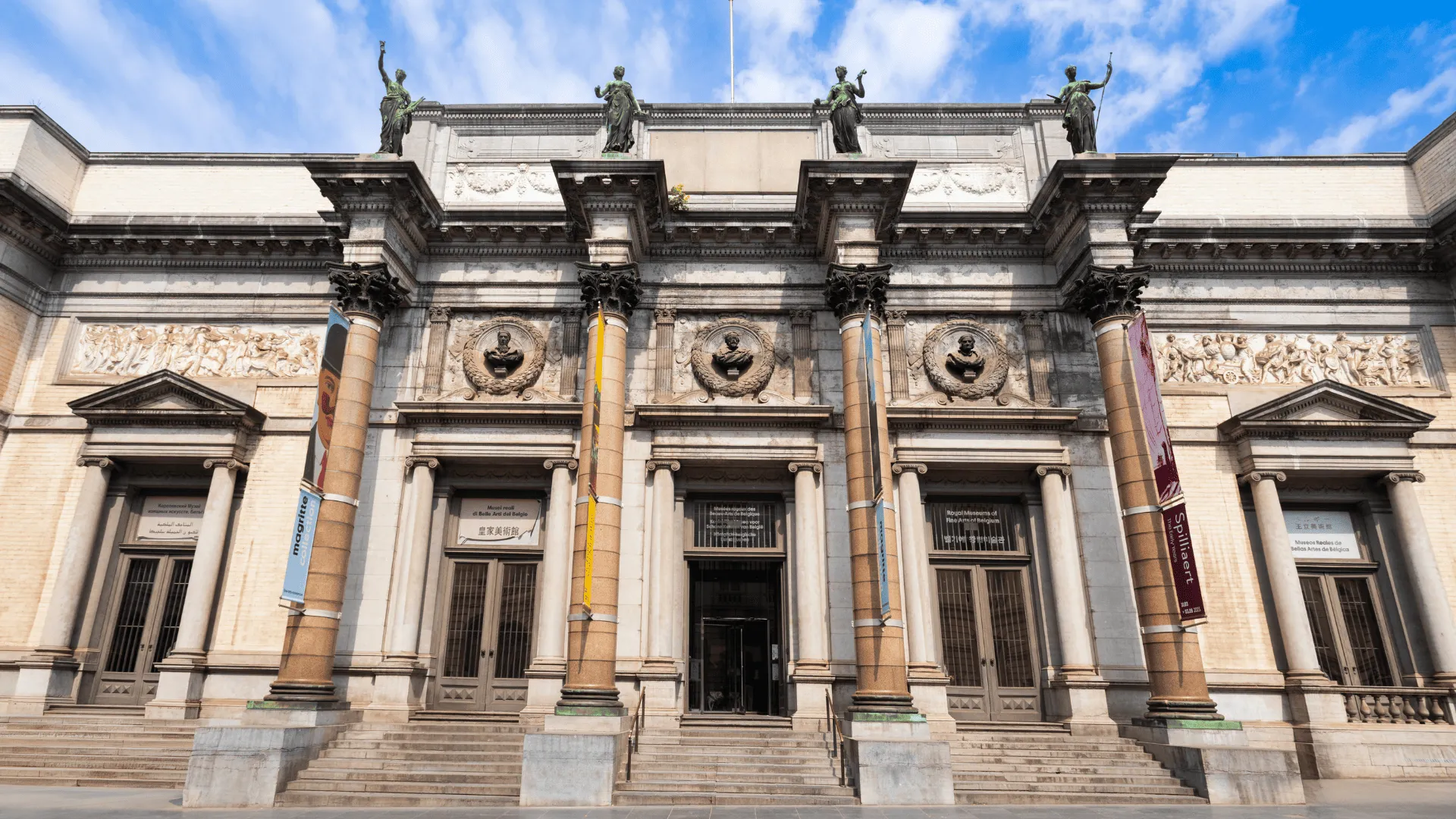
The Royal Museums of Fine Arts on rue de la Régence are home to one of Europe’s most significant collections and it is the Bruegel the Elder room that consistently draws the longest gaze. The Fall of the Rebel Angels and The Census at Bethlehem are among the most important Flemish works in existence. Beyond Bruegel, the collection spans seven centuries of Belgian and international art across the Old Masters Museum, the Museum of Modern Art and the Wiertz Museum.
Allow three to four hours. Come on a Tuesday or Wednesday morning to avoid weekend crowds.
Practical information
- Address: Rue de la Régence 3, 1000 Brussels, 10 minutes on foot from Hotel Alma and Hotel Aris Grand-Place
- Hours: Tuesday to Friday 10:00–17:00, Saturday and Sunday 11:00–18:00. Closed Mondays.
- Price: €10 adults, book online to avoid queues
- Combined with: the Magritte Museum (separate ticket, same building)
The Magritte Museum: surrealism in its home city
René Magritte was born in Lessines, worked in Brussels, and died in Brussels. The Magritte Museum located within the Royal Museums complex holds over 200 of his works: paintings, drawings, sculptures, advertising posters, photographs and films. It is the world’s largest collection of his output, and it traces his full career from early commercial work to the canonical images known worldwide.
The bowler hat. The pipe. The green apple. The man falling. Seeing the originals their scale, their texture, the particular quality of Magritte’s painted surfaces, is a different experience entirely from reproductions.
Practical information
- Address: Same complex as the Royal Museums, Rue de la Régence 3
- Hours: Monday to Friday 10:00–17:00, weekends 10:00–18:00
- Price: €13 adults · €11 groups (15+) · €6 children 6–11 · Free under 5
- Suggested visit: 60 to 75 minutes
The Musical Instruments Museum: architecture as much as music
The MIM is among the most unusual museum experiences in Europe: 8,000 instruments from around the world, with wireless headphones that play each instrument as you approach it. The technology is simple and the effect is remarkable, a violin plays when you stand in front of a violin, a sitar when you stand in front of a sitar, a Congolese drum when you reach that gallery.
The building is as significant as the collection: a former department store by architect Paul Saintenoy, completed in 1899, it is one of Brussels’ finest examples of Art Nouveau ironwork and glass. The rooftop café alone is worth a visit for the view over the city.
Practical information
- Address: Rue Montagne de la Cour 2, 1000 Brussels, 12 minutes from the hotel
- Hours: Tuesday to Sunday from 9:30. Last access at 16:30. Closed Mondays.
- Price: €15 adults · Free for children under 18
- Suggested visit: 90 minutes to 2 hours
The Comic Art Museum: a Belgian institution
Belgium invented the modern comic strip as an art form. Tintin, the Smurfs, Lucky Luke, Spirou, these characters did not emerge from anywhere; they emerged from Brussels. The Comic Art Museum on rue des Sables documents this history across permanent and temporary exhibitions, with a permanent 3D Smurf village that is more impressive than it sounds.
The building Victor Horta’s former Waucquez department store, completed in 1906, is itself on the Art Nouveau pass circuit. The combination of content and setting makes this one of the museums in brussels most worth visiting with or without children.
Practical information
- Address: Rue des Sables 20, 1000 Brussels, 12 minutes from the hotel
- Hours: Tuesday to Sunday. Closed Mondays.
- Price: €14 adults
- Suggested visit: 90 minutes
Plan your museums in Brussels visits: the Brussels Museums pass
Brussels Museums the official platform covering all 125+ museums in the city, publishes an annual guide, updated for 2026, with current exhibitions, nocturnal events (Nocturnes 2026) and the Art Nouveau Pass for visitors interested in the city’s architectural heritage.
For guests planning a stay built around Brussels’ cultural offer, our 2-day itinerary suggests how to combine the best museums with the rest of the city and members of Club Arbany Hotels who book direct benefit from exclusive rates that leave more of the budget for museum tickets.
The most romantic places in Brussels are not the ones that announce themselves. They are the ones you find by walking slowly: a covered arcade that smells of pralines at 9am, a medieval square that transforms into theatre after dark, a canal nobody told you about. Brussels is a city of small discoveries, and for couples, that quality is precisely what makes it worth choosing over the more obvious European destinations.
In winter, the Brussels romantic places that matter most come into their own. The crowds that dilute July’s Grand-Place have entirely disappeared. The light is lower and more dramatic. The chocolatiers produce their finest seasonal collections. And the city, stripped of its summer scaffolding, reveals the architecture and atmosphere that make it genuinely special.
Romantic things to do in Brussels: the places that make the difference
The Grand-Place at night
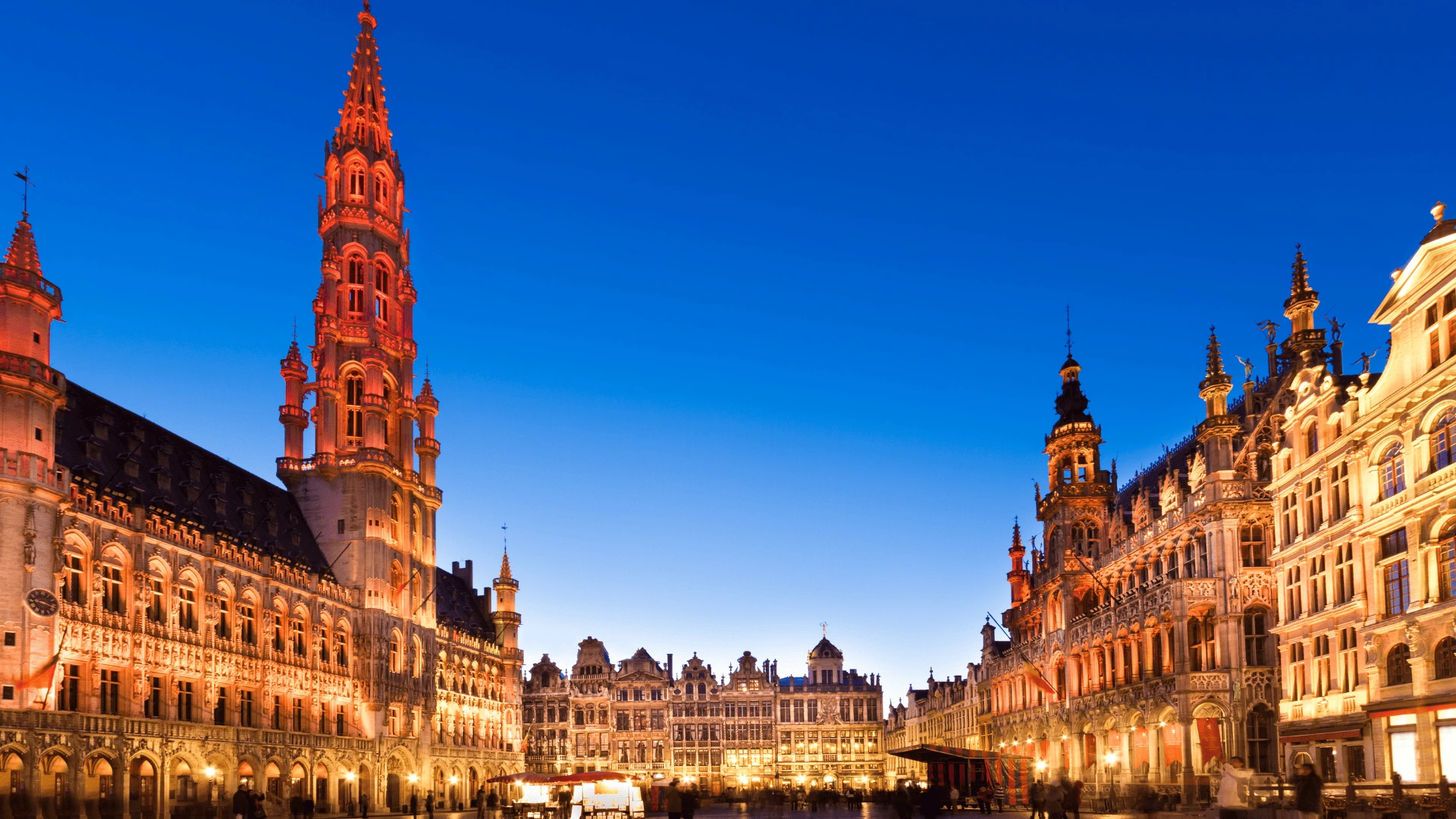
The Grand-Place is one of Europe’s most beautiful squares in daylight. At night, particularly in November and December when the Winter Wonders sound and light show projects animated sequences onto the 17th-century guild house facades, it becomes something else entirely. The show runs nightly from 5pm to 10pm, free of charge, and lasts approximately six minutes. On a cold evening, standing in the centre of the square as the music begins and the facades come to life, the effect is genuinely difficult to photograph in a way that does it justice. Go once before dinner and once after, the experience changes completely depending on the crowd.
The Galeries Royales Saint-Hubert
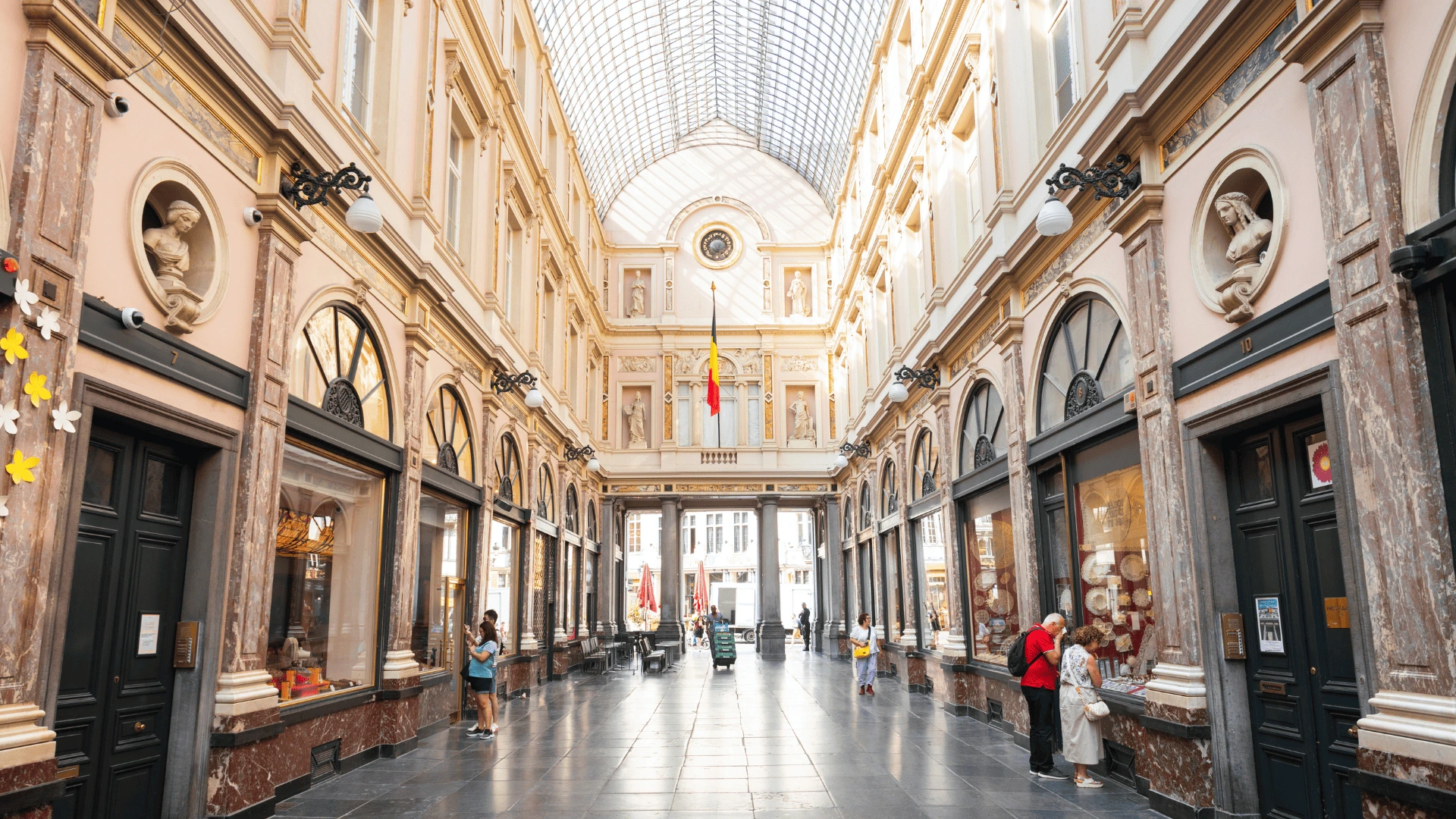
Built in 1847 and predating Milan’s Galleria Vittorio Emanuele II by twenty years, the Galeries Royales Saint-Hubert are among the most beautiful romantic things to do in Brussels for a couple who value architecture and slow mornings. One minute from Aris Grand-Place hotel, the covered arcade houses Neuhaus (inventor of the Belgian praline in 1912), independent jewellers and cafés with tables directly on the arcade promenade. On a winter morning, when the heat from the shops rises into the glass vault and the city is still waking up outside, it is one of the most pleasant places in Europe to simply be.
Mont des Arts, the view that stays with you
The Mont des Arts terrace, ten minutes from both hotels, offers one of the finest views of the Brussels skyline: the Town Hall spire to the north, the Royal Palace to the south, the Magritte Museum below. At dusk in winter, when the city is lit and the sky above the roofline is still faintly orange, it is one of the most consistently beautiful moments Brussels offers couples. No ticket required. No crowd. Just the view.
The Magritte Museum
The Magritte Museum at rue de la Régence 3 holds over 200 works by Belgium’s most internationally recognised artist. The paintings stranger, funnier and more technically accomplished in person than any reproduction suggests generate more genuine conversation per square metre than most European galleries. For a couple spending an afternoon in a museum, this is the one. Book online; closed Mondays.
Brussels honeymoon: a city that rewards the unhurried
Brussels is not the first city that comes to mind for a honeymoon in Brussels, and that is precisely why it works. There are no tourist convoys. No queues that last an hour. No sense that you are doing what everyone else is doing. The city is compact enough to walk entirely, varied enough to fill several days without repetition, and refined enough in its chocolate, its architecture, its cuisine to feel genuinely special.
The Sablon: Brussels’ most intimate romantic district
The Place du Grand Sablon is where Brussels puts its most intimate face forward. On Saturday and Sunday mornings (9:00–18:00), the antiques market occupies the cobblestones in front of the Notre-Dame du Sablon church, dealers offering silverware, jewellery, paintings and rare books while the city moves at the pace of a conversation rather than a commute. Wittamer at number 6 has been on the square since 1910: the hot chocolate served upstairs in the café is, on a cold December morning, one of the best things you will consume in Brussels. The full story of the Sablon’s recent transformation, new luxury boutiques alongside the historic institutions is in our dedicated guide.
A canal morning with Rivertours
Rivertours offers year-round boat tours from Boulevard d’Ypres 84, giving a perspective of Brussels that most visitors never discover: the Tour & Taxis complex, the working port, the Art Nouveau warehouses along the water. A morning on the canal before the city fully wakes, particularly in the low winter light, is the kind of shared experience that stays with you. Less expected than a museum, more memorable than a restaurant.
Dinner on the Sablon or in the city centre
For a honeymoon dinner, Comme Chez Soi at Place Rouppe 23, Michelin-starred, Art Nouveau interior by Victor Horta, fewer than 50 covers is the most prestigious table in Brussels for a special occasion. Book two months in advance for weekend evenings. For something equally considered but less formal, Au Vieux Saint Martin at Place du Grand Sablon 38 holds a Michelin Plate and offers a heated terrace in December, the square as a backdrop, the church lit behind you, the evening unhurried. As we covered in our winter restaurant guide, both deserve advance booking.
Where to stay: the Brussels romantic break at Alma Grand-Place hotel
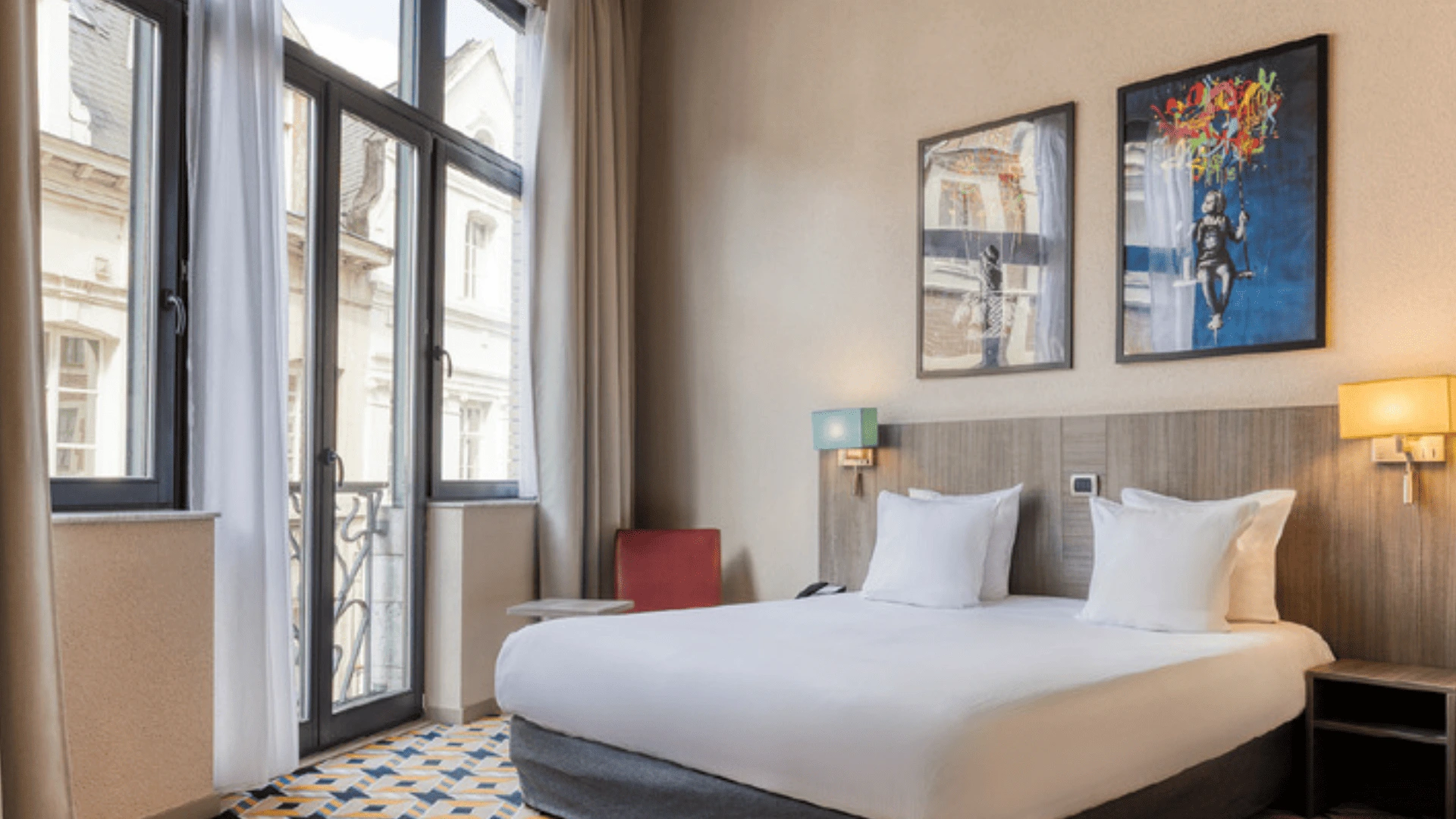
The Brussels Romantic Gourmet Break at Alma Grand-Place hotel is our package designed specifically for couples: the Premium King Room, combined with Belgian chocolates, a bottle of wine and a 10% Club Arbany Hotels discount.
In our view, Brussels in October is at its most authentic. The summer crowds have thinned out. The light takes on golden hues over the Grand-Place. The outdoor cafes are still warm enough to enjoy a long afternoon coffee, and the cultural calendar is filling up again with the confidence of a city that knows what it does best. October in Brussels isn’t a consolation prize for those who missed the summer: it’s a season worth visiting in its own right, with unique pleasures that July simply can’t offer.
From these two hotels, located a two-minute walk from the Grand-Place, everything listed below is accessible without a car, without the metro, and often without the tram. This proximity is the starting point for everything.
What to do in Brussels in autumn: museums, culture and the city’s finest interiors
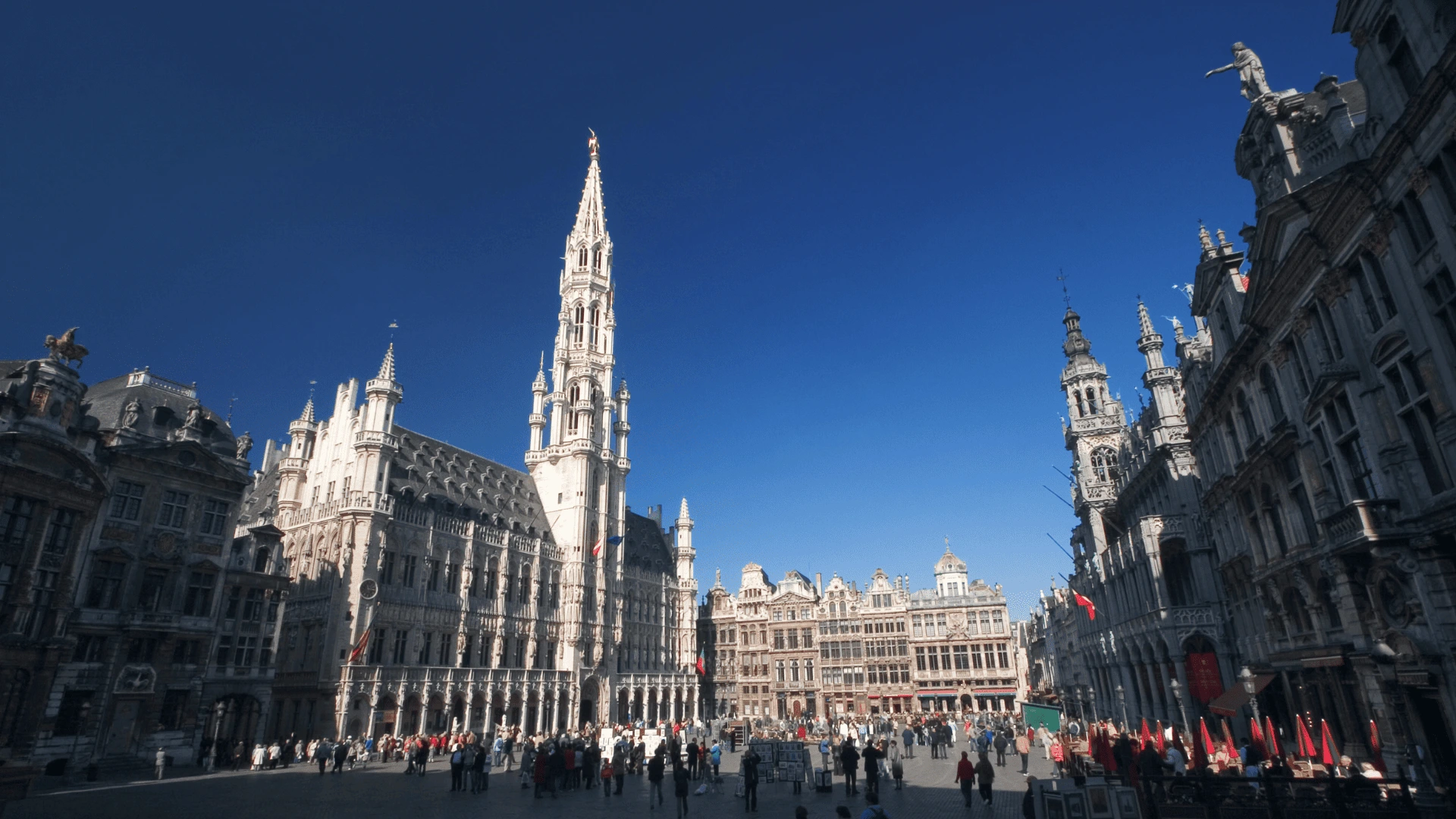
Autumn is when Brussels’ museum offer makes the most sense. When it rains and in October in Brussels, it will the city’s exceptional concentration of collections becomes a genuine resource rather than a rainy-day fallback.
The Royal Museums of Fine Arts of Belgium on rue de la Régence a 10-minute walk from both hotels, span seven centuries of Belgian and international art. The world’s largest collection of works by Pieter Bruegel the Elder is here, alongside the Magritte Museum within the same complex: over 200 works by the Belgian surrealist, in a building whose Art Nouveau architecture is itself worth the visit. Allow a full day for both.
The Musical Instruments Museum (MIM) on rue Montagne de la Cour is one of Europe’s most genuinely unusual museum experiences: 8,000 instruments from around the world, with wireless headphones that play each one as you approach it. The building a Paul Saintenoy Art Nouveau department store completed in 1899, houses a rooftop café with views over the city that are particularly dramatic on an October afternoon with low cloud over the spires.
Museum Night Fever, usually held in mid-October, opens Brussels’ museums late into the night with concerts, workshops and candlelit guided tours. It is one of those events that regular Brussels visitors return for every year. Programme and tickets at visit.brussels.
For families or guests who want something further afield, the Atomium Brussels’ most eccentric landmark, built for the 1958 World’s Fair, is best visited on a grey October afternoon when queues are shorter and the views over the misty city from the top sphere are genuinely memorable. Mini-Europe next door is worth an hour if you are travelling with children.
Brussels in November: the city before the festive season begins
Brussels in November has a quality that is easy to overlook. The month sits between October’s cultural intensity and December’s Christmas market spectacle and it is, for that reason, one of the most pleasant times to visit without a specific agenda.
The city’s traditional beer cafés come into their own. À la Mort Subite on rue Montagne aux Herbes Potagères, Brussels’ reference address for lambic and gueuze, unchanged since 1928 is at its best when it is cold outside and warm within. Bier Circus on rue de l’Enseignement offers a more guided introduction to the Belgian beer landscape, with tasting notes and food pairing suggestions.
Late November marks the opening of Winter Wonders, Brussels’ official Christmas market, running from 27 November 2026 across nine squares connected by a 2.5-kilometre trail of lights. The first week is consistently the most atmospheric: the installations are fresh, the chalets are fully stocked, and the Grand-Place sound and light show draws its opening-week crowds.
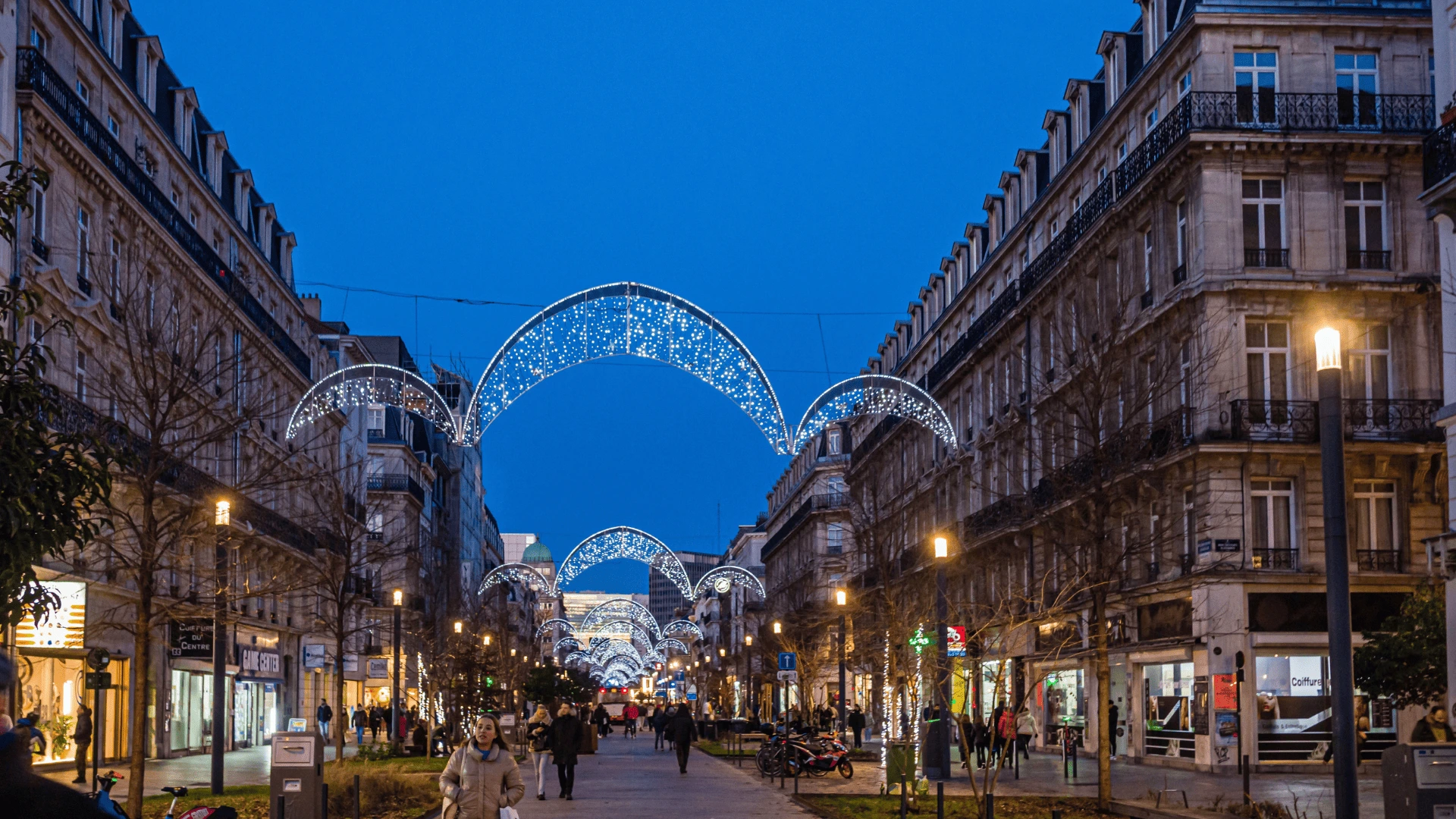
Temperatures in November range from 4°C to 11°C. Pack layers and a compact umbrella. Public transport: a single STIB journey costs €2.40, capped at €8.40 per day with contactless payment.
Autumn walks in Brussels, three routes worth your time
Brussels in autumn rewards slow walking. Three routes we recommend to guests staying near the Grand-Place:
The Sablon loop: walk south from the hotel to the Place du Grand Sablon (10 minutes), browse the antiques market on Saturday mornings (9:00–18:00), have a coffee at Wittamer on the square, then continue to the Petit Sablon garden and up to the Place Royale for the view over the lower city. Return via the Galeries Royales Saint-Hubert, one minute from Hotel Aris Grand-Place. The whole loop takes 90 minutes at a gentle pace. The full story of the Sablon’s recent transformation is in our dedicated guide.
The Art Nouveau route: Brussels has more Art Nouveau buildings per square kilometre than any other city in the world. The BANAD festival opens usually-closed interiors in spring, but the facades are there year-round. Rue Defacqz, rue Faider and rue Paul Emile Janson in Saint-Gilles are the streets worth walking. The Horta Museum at rue Américaine 25 is the essential stop, the former home and studio of Victor Horta, the architect who defined the movement. Book ahead, visitor numbers are strictly limited.
The parks circuit: Parc de Bruxelles (10 minutes from both hotels) and Parc du Petit Sablon are both at their most beautiful in October when the leaves turn and the morning light comes low through the trees. Bring a book. Bring a coat.
Our guide to the best museums in Brussels covers opening times, prices and honest advice on how long to spend in each. For questions about breakfast, parking and late check-out everything practical for an autumn stay, our FAQs page has the full picture.
Brussels New Year’s Eve is built around one of the most spectacular free fireworks displays in Europe: the official show at the Atomium, where laser projections, flame effects, pyrotechnics and 3D mapping of the iconic nine-sphere structure combine into a midnight spectacle that drew nearly 50,000 spectators last year. It is free. It is outdoors. It starts at 9pm and finishes well past midnight. And it is, by any measure, the right way to see Brussels on New Year’s Eve.
This guide covers the official celebrations, where to eat before midnight, how to get around the city on the night, and what the Grand-Place area looks like at 12:01 on 1 January 2027.
New Year Brussels 2027: the official fireworks at the Atomium
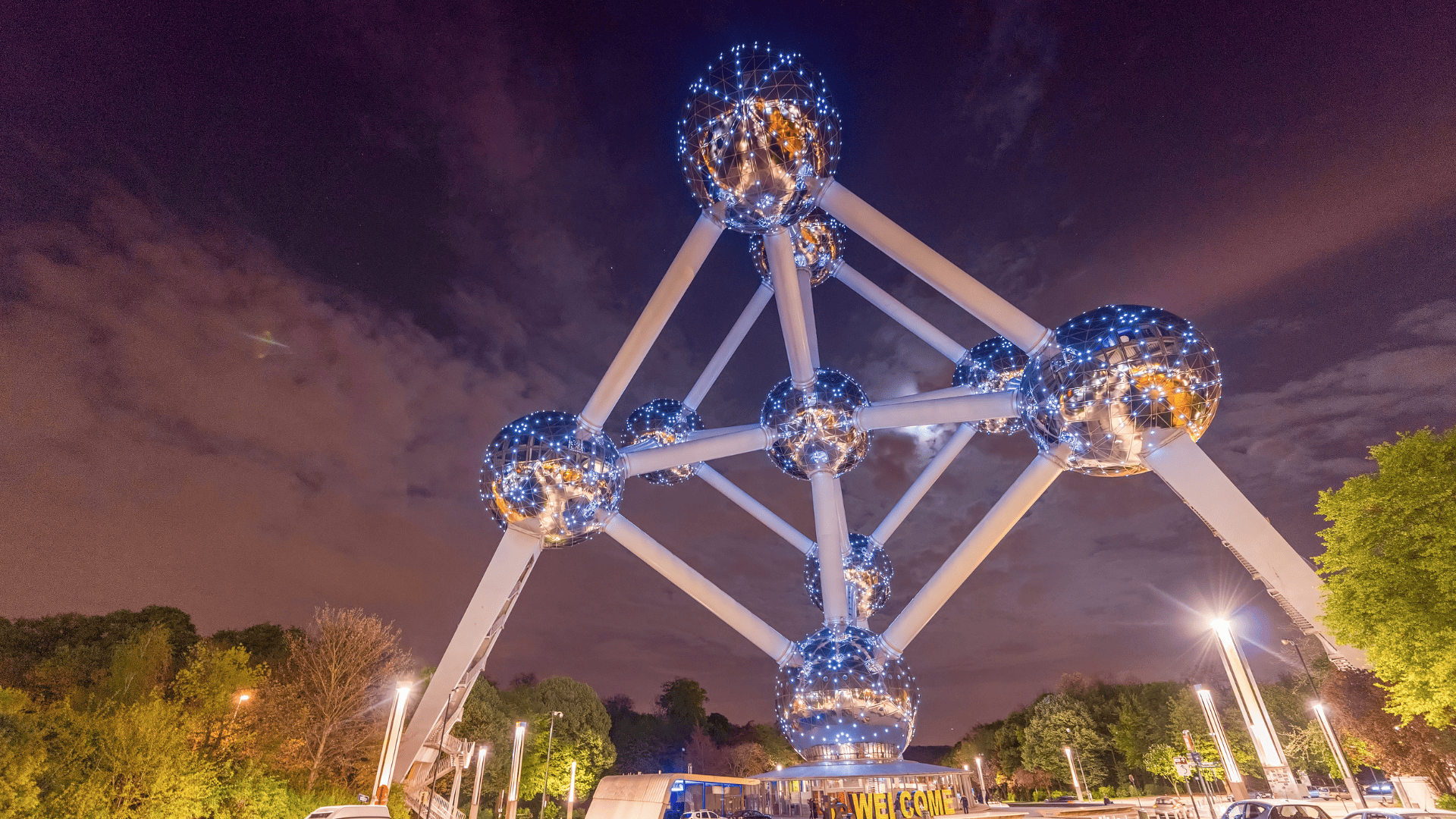
The centrepiece of Brussels New Year’s Eve 2026 is the official show at the Atomium esplanade, Place de l’Atomium, 1020 Brussels (Laeken). Organised by Brussels Major Events and free of charge, the evening unfolds in three acts:
From 9pm: DJ sets warm the crowd on the esplanade. Food trucks, mulled wine and the glow of the Atomium above the crowd. Arrive early, the esplanade fills up.
From approximately 11:30pm: “Fusion”, the official Brussels New Year’s production, begins combining laser projections, flame effects from ground and elevated platforms, and 3D mapping of the Atomium’s steel spheres. The production is designed specifically for this site and changes from year to year.
At midnight: fireworks launched simultaneously from multiple platforms, synchronised to an original electro-pop composition. The display is visible from several kilometres across the city.
Getting there: Take metro line 6 to Heysel or tram 7 to Atomium. The entire STIB network metro, tram and most bus lines, is free from midnight until the start of regular service on 1 January. Night buses and tram 81 run from midnight to 5:30am. Do not drive: the Heysel district is completely closed to traffic from early evening.
What to bring: Dress warmly. Glass bottles are banned on the site. Bag searches are carried out at the entrance. Private fireworks are prohibited throughout the Brussels-Capital Region.
More information on timing and programme at plaisirsdhiver.be.
What to do in Brussels on New Year’s Eve
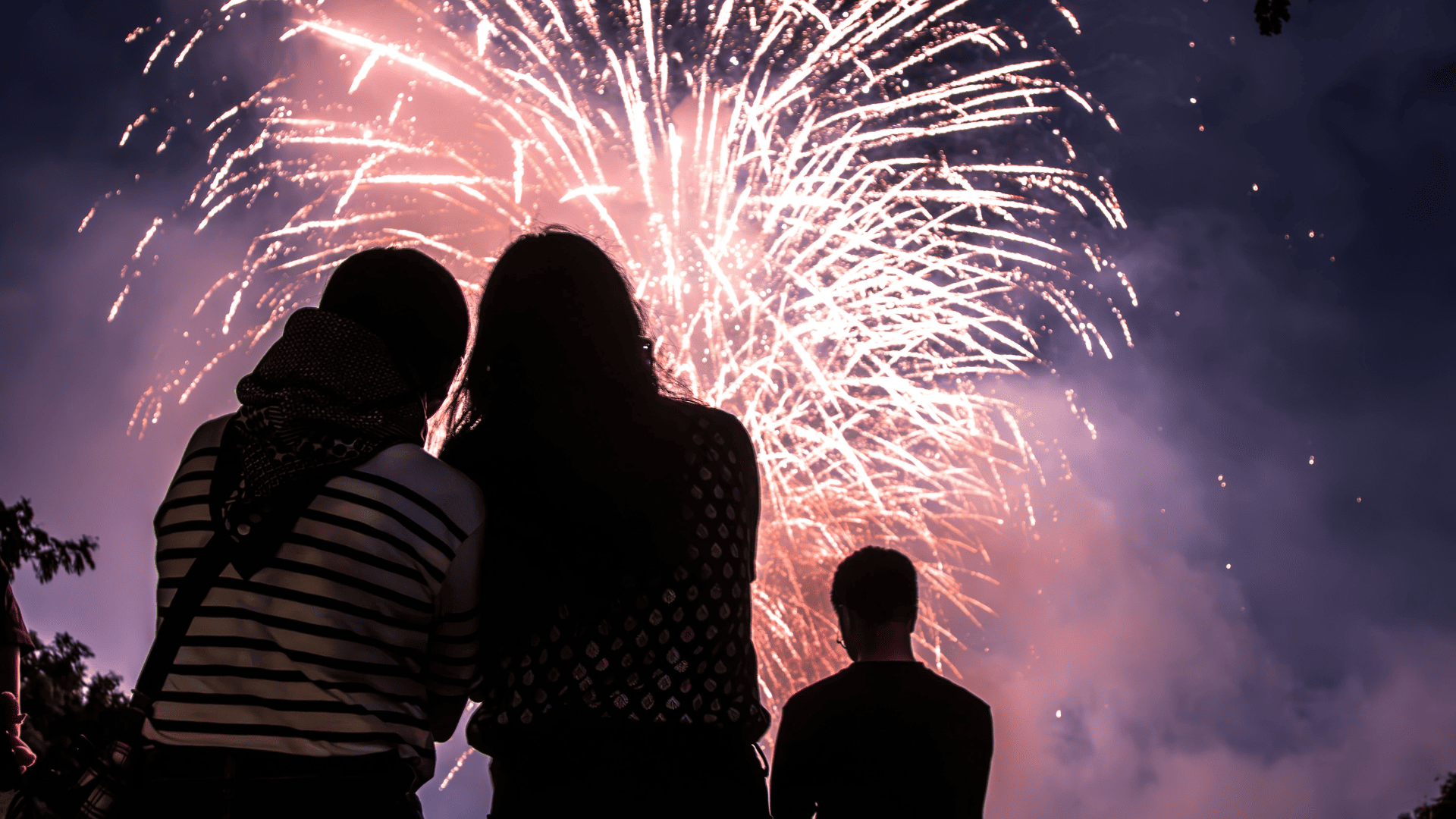
Not everyone wants to stand in a crowd of 50,000 people in January temperatures. Brussels offers several alternatives that are worth knowing.
The Grand-Place at midnight
There are no official fireworks in the Brussels city centre, but the Grand-Place on New Year’s Eve has its own quality. The sound and light show does not run on 31 December (Winter Wonders closes at 6pm), but the square remains illuminated and increasingly crowded as midnight approaches. Champagne glasses appear from coat pockets. Strangers exchange bonne année. The guild house facades, lit against a dark January sky, are extraordinarily beautiful at this hour.
For guests staying at Alma Grand-Place hotel or Aris Grand-Place hotel, the Grand-Place is two minutes on foot. Walking there for midnight and returning on foot twenty minutes later without transport, queues or crowds is the city centre alternative to the Atomium that many guests choose.
Place de Brouckère
In recent years, a giant countdown clock has been projected onto the façade of the Brouckère building, drawing a crowd for the final minutes before midnight. Less spectacular than the Atomium but considerably more central and easier to reach on foot from the hotels.
FCKNYE Festival
Belgium’s largest New Year’s Eve festival runs at Tour & Taxis, with over 50 artists across four stages. The programme typically mixes electronic music, hip-hop and live performances. Tickets sell out weeks in advance. Check fcknye.be for the 2026 programme and lineup.
Where to eat on Brussels New Year’s Eve?
New Year’s Eve restaurant reservations in Brussels close faster than any other date in the calendar. The addresses worth booking first:
Comme Chez Soi at Place Rouppe 23 offers a special New Year’s Eve menu, Michelin-starred, Art Nouveau interior, the most prestigious table in Brussels for the occasion. Book two months in advance.
Au Vieux Saint Martin at Place du Grand Sablon 38 Michelin Plate 2024 and 2025, offers a festive New Year’s menu with the option of watching midnight from the square afterwards. Book at least three weeks ahead.
For a more convivial, less formal evening, Bouillon Bruxelles on rue des Dominicains, five minutes from the hotels, takes reservations for New Year’s Eve and offers its full Belgian menu. The atmosphere on the night is reliably warm.
Several Brussels hotels and venues offer gala dinner packages the Music Village jazz club consistently delivers a well-regarded dining and live music combination. Check their programme directly.
Staying in Brussels for New Year’s Eve
Availability at well-located hotels for 31 December fills up from early December. Both Alma hotel and Aris Grand-Place place hotel you in the centre of the city’s New Year’s Eve geography, two minutes from the Grand-Place, five minutes from Central Station and its connections to the Atomium tram line.
Our Alma Grand-Place and Aris Grand-Place offers include packages available exclusively when booking direct, no intermediary fees, best rate guaranteed, and free Club Arbany Hotels membership from your first night. For questions about check-in times, luggage storage and late check-out on New Year’s Day, our FAQs page has everything you need.
For the full picture of what Brussels has to offer in December beyond New Year’s Eve, our December city guide covers the month from Winter Wonders to the final days of the year.
When most visitors think of Christmas in Brussels, they think of the Grand-Place: the sound and light show, the 200-plus chalets, the mulled wine and the crowds. All of it is worth experiencing, as we covered in our complete Christmas market guide. But there is another Brussels Christmas that runs alongside Winter Wonders, quieter, more intimate and arguably more interesting: the Grand Sablon in December.
Ten minutes on foot from Alma Grand-Place hotel, the Place du Grand Sablon in winter is the address where Brussels’ residents prefer to spend their Saturday mornings in December, and where the city’s festive season reveals a side that the tourist brochures rarely describe.
Sablon Brussels winter: the antiques market in December
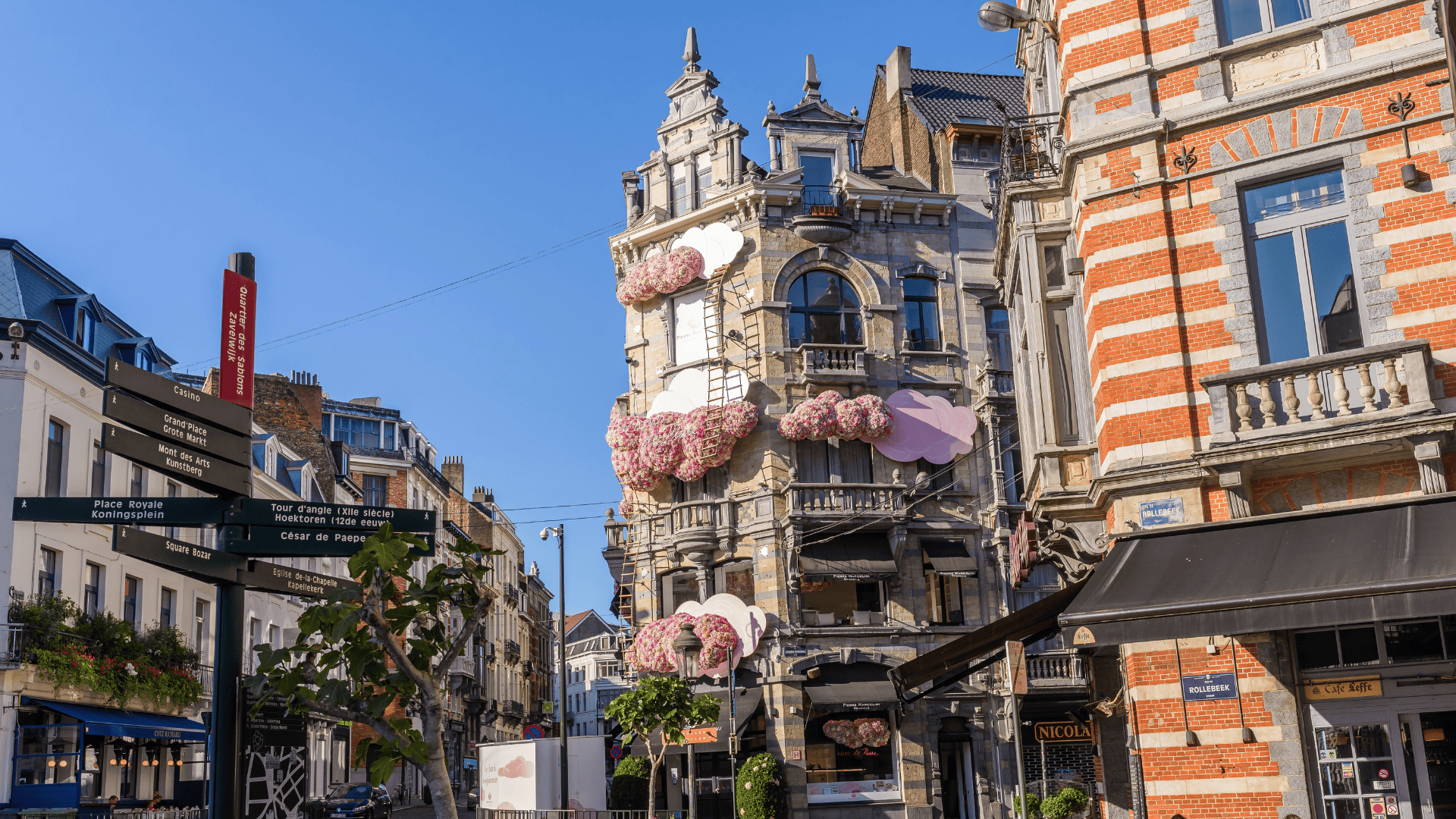
The Sablon Antiques Market has been running on the Place du Grand Sablon every Saturday and Sunday since 3 April 1960, when a single antique dealer named Georges Van de Weghe received permission from the priest of Notre-Dame du Sablon to display his engravings after mass. Gradually, others joined him, and what began as an informal arrangement has become one of the oldest and most respected antiques markets in Belgium.
In December, the market runs against the backdrop of the Notre-Dame du Sablon church — a 15th-century Brabantine Gothic masterpiece whose flamboyant facade is lit at night throughout the festive season. The dealers set up their stalls on the cobblestones from 9am on Saturdays and Sundays, displaying silverware, jewellery, ceramics, paintings, Chinese porcelain, African art, watches and books. The cold concentrates the atmosphere: dealers wear heavy coats and offer advice in three languages; collectors arrive early with purpose; and occasional visitors wander between stalls with the unhurried pleasure of people who have nowhere else to be.
The market closes at 6pm. Getting there: tram 92 or 93 from the city centre (stop: Kleine Zavel), or ten minutes on foot from the hotels via rue de la Régence.
Antiques market Sablon December: what to find and what to buy
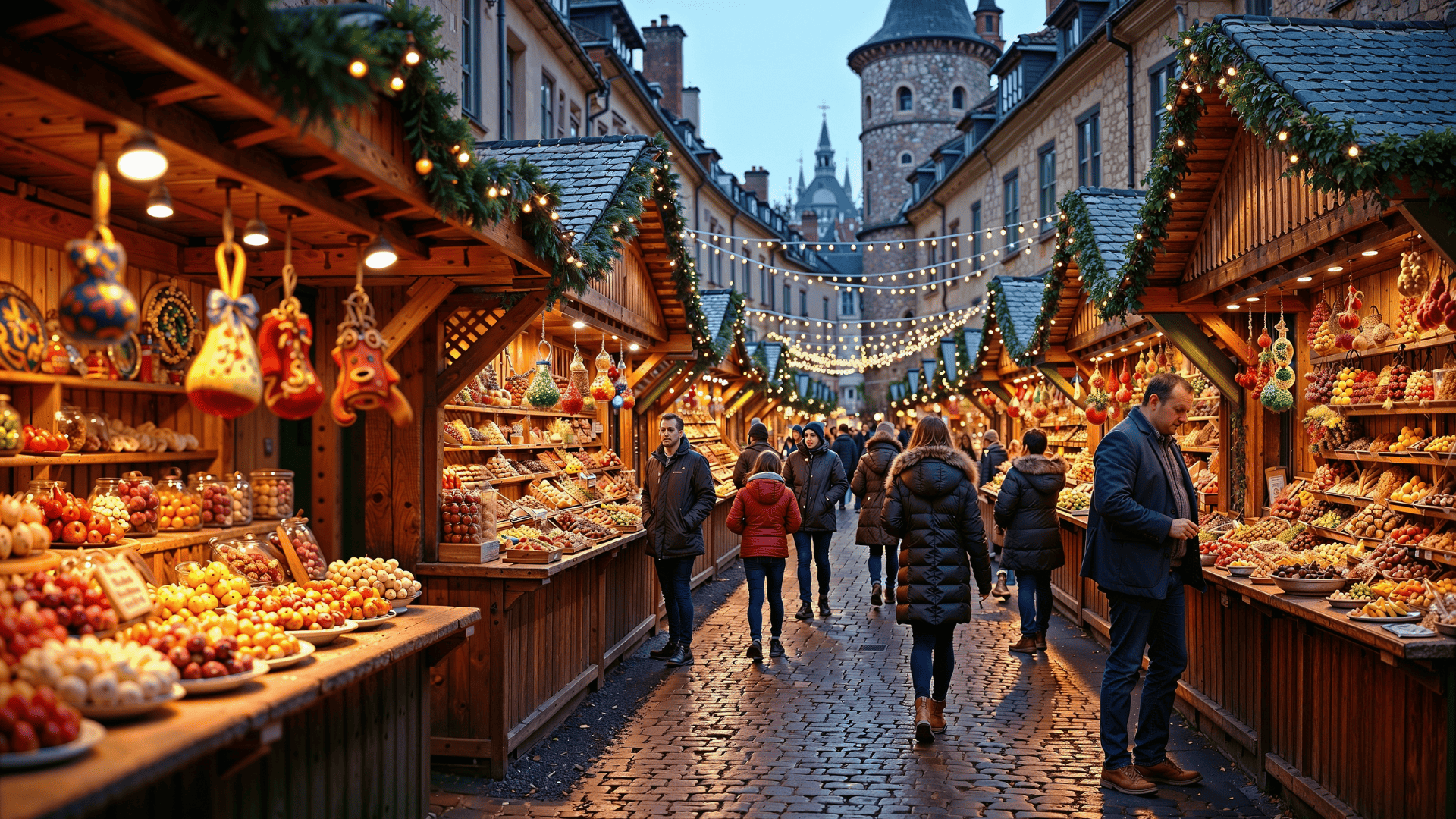
December is one of the best months to visit the Sablon market because the dealers arrive with their finest seasonal pieces: ornate candlesticks, vintage silverware, Art Deco jewellery, decorative objects that read as gifts. The selection is genuinely eclectic, a Flemish oil painting beside a Japanese lacquer box beside a set of 1930s cocktail glasses, and the dealers, most of whom have occupied the same pitch for years, are unfailingly knowledgeable and willing to discuss the provenance of anything on display.
What tends to appear specifically in December: Christmas-related antiques (vintage advent calendars, early 20th-century decorations, Belgian Art Nouveau ornaments), gift-quality silverware and porcelain, and the particular category of small decorative objects that make presents no one else will have given.
The market is free to enter. Prices range from a few euros to several thousand. Negotiation is accepted, expected and conducted with mutual courtesy.
The chocolate and festive tables of the Sablon in winter
No visit to the Sablon in December is complete without stopping at Wittamer at Place du Grand Sablon 6 and 12. The Official Supplier to the Court of Belgium since 1910 produces its most elaborate seasonal collections in November and December: praline boxes in Christmas packaging, bûches de Noël crafted with the precision the house applies to its year-round work, and the hot chocolate served in the upstairs café which, on a December morning after an hour at the antiques market, is one of the best things you will consume in Brussels.
Pierre Marcolini at rue des Minimes 1, steps from the square, releases its winter seasonal collection in late November. The single-origin chocolates in Christmas packaging make the most considered edible gift you can bring back from Brussels. As we described in our chocolate guide, the Sablon concentrates more serious chocolate per square metre than any other district in the city.
The new boutiques: the Sablon’s second reason to visit
The Sablon in December 2026 is not only the antiques market and the chocolatiers, it is also the neighbourhood in the middle of its most significant transformation in decades. The new boutiques that have arrived over the past eighteen months AMI Paris at number 5, Breitling at number 8, Christian Louboutin at number 21, are lit from within in December, their windows dressed for the season. Yvan’s, the Brussels jewellery house, operates from its new Sablon location alongside its historic address in the Galeries Saint-Hubert.
The combination of 16th-century church, 60-year-old antiques market, century-old chocolate institutions and brand-new luxury boutiques is unique to this square. It is why the Sablon in December is more interesting than a single category of destination, and why it rewards more than one visit during a stay of several days.
For dinner after an afternoon on the square, Au Vieux Saint Martin at number 38 remains our standing recommendation: Michelin Plate 2024 and 2025, heated terrace in December, open seven days a week. Book for weekends. The full context of the Sablon’s transformation, the Immobel project, the new arrivals, the city’s ambitions for the square is in our dedicated Sablon guide.
Getting to the Sablon from the hotel
From Alma Grand-Place hotel and Aris Grand-Place hotel, the Place du Grand Sablon is a ten-minute walk south through the historic city centre, via the Mont des Arts terrace and rue de la Régence, or through the Petit Sablon garden. Both routes are pleasant on a December morning, particularly if the market is your destination and you have time to stop along the way.
The walk back in the evening, when the church and the boutiques are lit and the square is quiet, is the version of Brussels that most visitors miss entirely, and the one that stays with you longest.
Sablon Brussels is one of those neighbourhoods that evolve quietly, and others that reinvent themselves with a kind of quiet confidence.
The Sablon has attracted Brussels’ elite since the 16th century antique dealers, art galleries, master chocolatiers. Today, something new is happening. Luxury fashion houses are arriving, an ambitious architectural project is reshaping the streetscape, and city leaders are talking openly about making this one of Europe’s finest squares. At Alma Grand-Place hotel, we are right at the doorstep of this transformation and we think you should know about it.
Sablon Brussels: a square with centuries of prestige
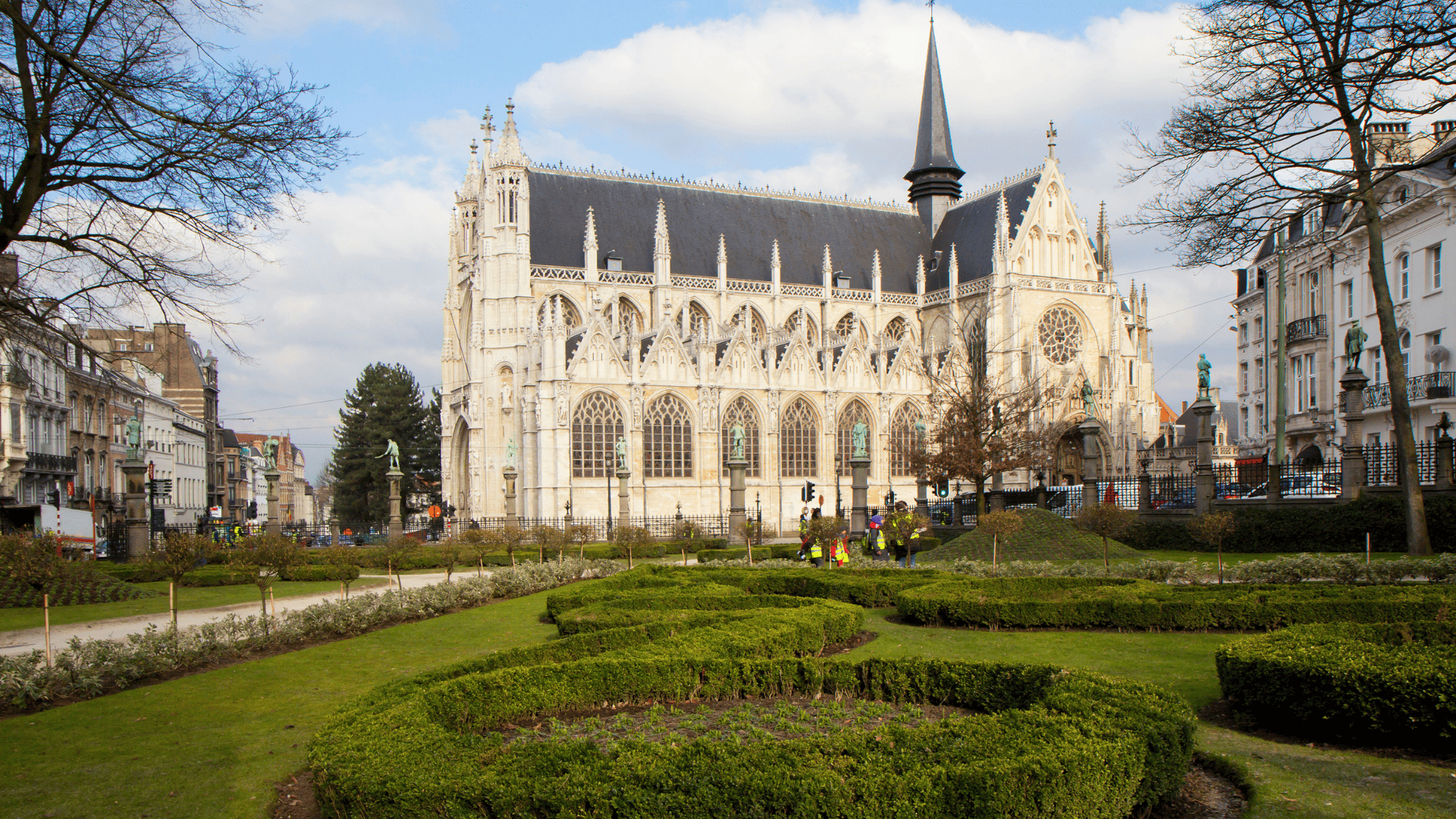
The Place du Grand Sablon has always been Brussels’ most elegant address. Every weekend, the antiques and book market takes place in front of the Sablon Church, drawing collectors and curious visitors from across Europe. The square is framed by listed facades, lined with chocolate institutions and watched over by the Church of Our Lady of Victories, one of Brussels’ finest examples of Brabantine Gothic architecture.
What has always set the Sablon apart from other luxury districts is its human scale. It is a square you walk, linger in, and return to, not a boulevard you merely pass through. That intimacy is precisely what is attracting a new generation of prestigious brands.
Luxury shopping in Brussels
The transformation is already visible on the square. In November 2025, AMI Paris opened its first Belgian flagship at 5 Place du Grand Sablon a 190-square-metre space set within a former antiques shop, blending understated modernity with respect for local heritage. The Parisian brand’s arrival signalled something clearly: the Sablon is now on the map for the world’s most discerning fashion houses.
A Hermès boutique is also expected to open at the Sablon in the near future, joining Rolex and Tag Heuer, two names already long established on the square. Christian Louboutin is also present at Place du Grand Sablon 21, bringing its signature red soles to this storied address.
Other new arrivals include Messika, Diptyque, Essentiel, Jaeger-LeCoultre and Breitling, a constellation of names that, taken together, signal a genuine shift in Brussels’ luxury geography.
Alongside these new entrants, the Sablon’s historic institutions remain firmly in place. Pierre Marcolini, one of Belgium’s most celebrated chocolatiers, continues to anchor the square. Taschen, the art book publisher, offers one of Brussels’ most beautiful browsing experiences. Flamant and Baobab complete a picture of refined, Belgian-rooted elegance.
The Immobel Lebeau project: a neighbourhood being reimagined
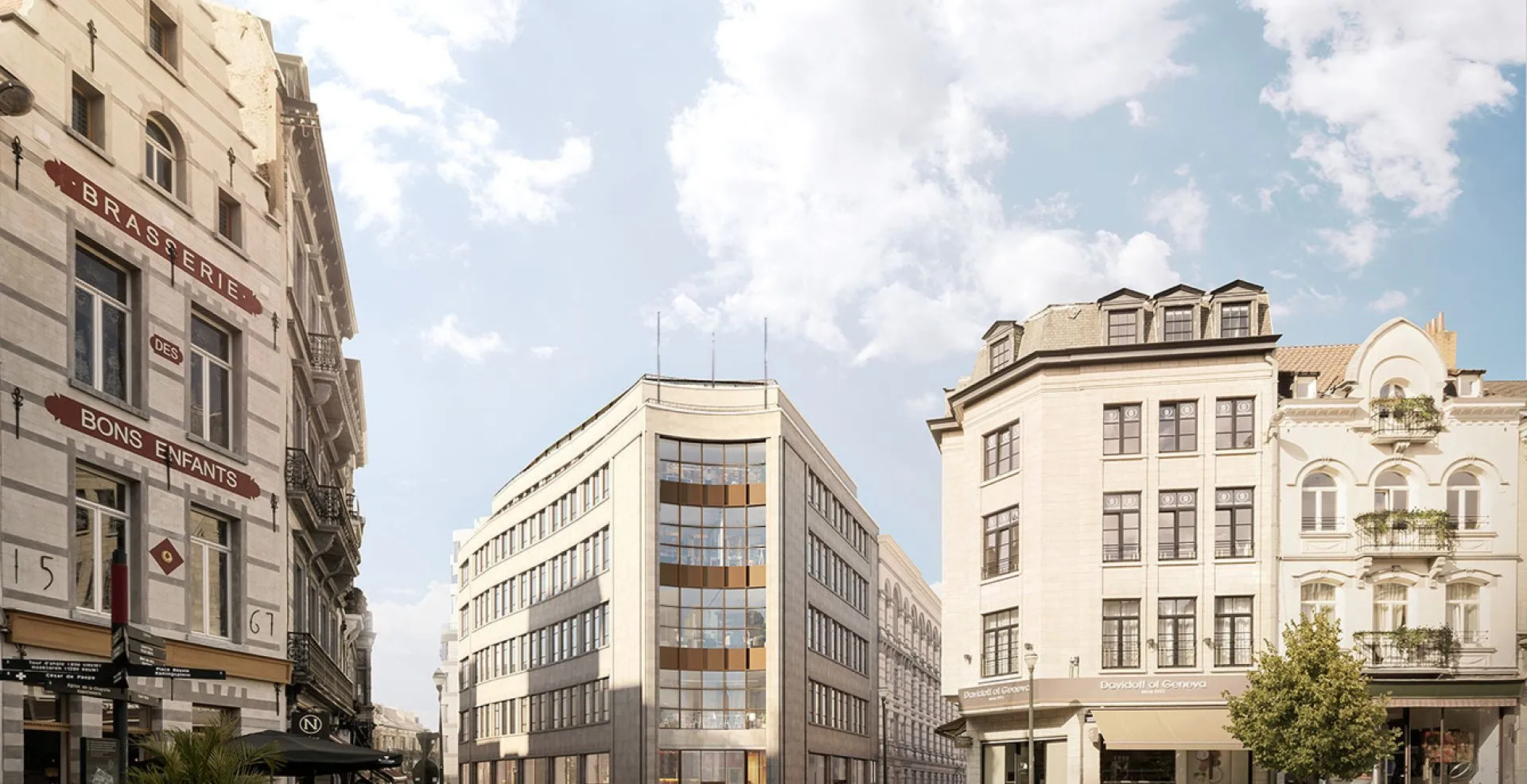
The physical fabric of the Sablon is changing too. The Lebeau project by Immobel is a unique mixed-use complex situated next to Place du Grand Sablon, comprising prestigious residential apartments, retail outlets, underground public parking and offices.
The project revised several times since 2019, received its urban planning permit in early 2024. It preserves 70% of the existing buildings, formerly used by the RTT (now Proximus), and includes 64 new apartments designed to high energy performance standards, a 1,500 m² interior garden, a two-level underground parking facility with over 300 bicycle spaces, and retail outlets along the rue Lebeau. The first residents are expected to take possession of their apartments by the end of 2026.
This is not mere renovation, it is a statement of intent. As Frédéric Ceulemans, Brussels’ Alderman for Urban Renewal, put it: “A positive wind is blowing over the Sablon again. We want to strengthen this momentum.” The city’s ambition is clear: to make the Sablon the most beautiful and most chic square in Belgium.
How to reach the Sablon from Alma Grand-Place hotel
From Alma Grand-Place hotel, the Sablon is an easy and entirely pleasant walk. Head south from rue des Éperonniers towards the Grand-Place, then continue along rue de la Madeleine or rue du Midi towards the square. The walk takes approximately 10 to 12 minutes on foot through some of Brussels’ finest streets.
Along the way, you will pass the Galeries Royales Saint-Hubert, cross the historic city centre, and arrive at the Sablon from the north side of the church, the best approach for taking in the square as a whole.
Our team at the front desk is always happy to recommend the best route, suggest which boutiques to visit first, and point you towards the best table for lunch or a coffee break in the neighbourhood. That local knowledge is something no map can quite replace.
If you are planning a stay around the Sablon’s new openings, our Brussels hotel offers include packages designed for guests who want to make the most of the city, including the Brussels Romantic Gourmet Break, perfect for a special occasion in one of Europe’s most quietly glamorous neighbourhoods.
Worth noting before you go
The Sablon antiques market runs every Saturday (9:00–17:00) and Sunday (9:00–13:00) on Place du Grand Sablon, an ideal complement to a morning of boutique browsing.
For a deeper look at what Brussels has to offer beyond the Sablon, our Discover Brussels guide covers the city’s finest attractions, all within walking distance of the hotel.
On September 4, 2025, Brussels joined the world in paying tribute to Giorgio Armani, one of its greatest fashion designers. Giorgio Armani, who passed away in Milan at the age of 91, leaves behind a legacy of timeless elegance that continues to inspire Brussels and beyond. A visionary and pioneer, Armani redefined fashion with restraint, refinement, and modern sophistication. His creations transcended the catwalk, shaping red carpets worldwide and leaving a lasting mark on luxury design, lifestyle, and hospitality.
The Elegance of Giorgio Armani: the Luxury of Simplicity
A Philosophy Beyond Fashion
More than a couturier, Giorgio Armani was an architect of style. His clean lines and minimalist aesthetic gave birth to a universal vision of refinement, where every detail counts. For Armani, true luxury was never synonymous with excess: it was synonymous with subtlety, restraint, and timeless beauty.
A Legacy Without Borders
Armani’s influence extended far beyond Italy. From Milan to Paris, New York, and beyond, his philosophy of elegance inspired generations. Today, his vision continues to resonate around the world as an art of living: understated, refined, and timeless.
A Tribute to Giorgio Armani in Brussels: European Capital of Style
A lifestyle rooted in elegance
Brussels is not only the capital of European institutions; it is also a city where design, architecture, and culture converge. From the majesty of the Grand-Place to the historic Galeries Royales Saint-Hubert, Brussels embodies refinement and charm. This tribute to Giorgio Armani in Brussels underlines how deeply the city resonates with his values of timeless elegance.
Luxury Shopping and Urban Chic

Avenue Louise, with its luxury boutiques, has become a must-see for fashion lovers. Among them, Armani has found a haven of peace, reflecting the connection between Brussels and the sophistication of his creations. Here, the Armani spirit endures, combining authenticity and modernity.
Arbany Hotels: hospitality inspired by the same values
Simple Elegance, Human Warmth
Located just steps from the Grand-Place, Arbany Hotels share values close to Armani’s vision of elegance. Our hotels combine comfort, serenity, and refined design. Like Armani, we believe that true elegance lies in attention to detail and in experiences that are both refined and authentic.
Refinement with a Sustainable Touch
Our commitment goes beyond comfort. From ozone cleaning to solar panels and energy efficiency, Arbany Hotels embody a contemporary vision of hospitality that is both refined and responsible. This approach reflects a new form of elegance modern, responsible, and timeless.
The spirit of Giorgio Armani in Brussels: a Living Tribute
While the world pays tribute to Giorgio Armani, his legacy lives on wherever authenticity meets elegance. Brussels, with its culture, architecture, and refinement, is the perfect setting for this tribute. At Arbany Hotels, we perpetuate this same spirit of hospitality, offering our guests simple, elegant, and deeply human stays. By paying tribute to Armani, we celebrate not only a creator, but also a philosophy of life that continues to inspire Brussels and beyond.
The end of the year is approaching, and it’s time to plan how you’d like to ring in the New Year. Brussels offers a multitude of options to suit all tastes and preferences.

New Year’s Eve fireworks at the Atomium
In the heart of Brussels, the Atomium is transformed into a spectacle of light and colour to welcome in the New Year. The traditional New Year’s Eve fireworks display is a not-to-be-missed event, offering a magical, family-friendly atmosphere. The baubles on the Atomium sparkle in sync with the music, creating a festive atmosphere. From 10pm onwards, a DJ leads the countdown to midnight, followed by an 18-minute fireworks display. Admission is free, making this an accessible and unforgettable event.
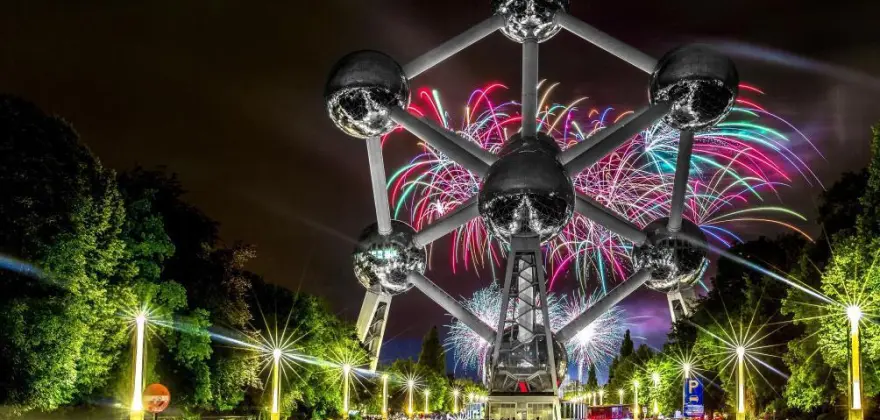
FCKNYE Festival
For a festive experience like no other, the FCKNYE Festival is a veritable Brussels institution. With four stages hosting 34 artists, including names such as PLK, Gazo, Hamza, Josman, Lorenzo, Amélie Lens, Vladimir Cauchemar, Dirtyphonics, and Ascendant Vierge, the evening promises to be electrifying. It’s the biggest New Year’s Eve party in Belgium and probably in Europe, guaranteeing an exhilarating celebration for all music fans.
Spirito: A wild party in a former church
Spirito, housed in a former Anglican church in Ixelles, offers nine hours of wild New Year’s Eve partying. This emblematic club, renowned for its diverse musical evenings ranging from Latino to hip-hop, house and rap, promises an exceptional New Year’s Eve party with three fiery DJ sets.
Chocolates and the Chocolate Museum: A Gourmet Celebration
From chocolate gifts to chocolate frangipani, the city is transformed into a sweet paradise. The Chocolate Museum is a must-see. You’ll discover the origins of cocoa and the history of its importation through captivating rooms and exhibitions. The highlight of the visit is a demonstration of the creation of a Brussels speciality, praline. The opportunity to taste chocolates from various Latin American countries completes this sensory experience.
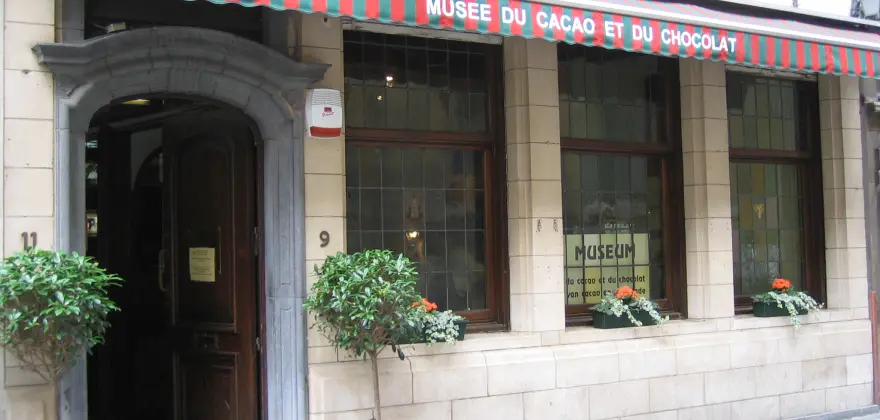
Réveillon de l’Improviste in Forest: An Intimate and Festive Party
For those looking for a more intimate New Year’s Eve party, the Réveillon de l’Improviste in Forest offers a warm and festive atmosphere. Although less massive than some other celebrations, this evening makes up for it with its friendly atmosphere. Artistic performances, lively music and careful decoration create an intimate and memorable experience to welcome in the New Year.
Viva Las Vegas, New Year’s Eve at the Viage: Entertainment and Animated Evenings
If you’re looking for a fun and lively experience, “Viva Las Vegas, New Year at the Viage” is the event not to be missed. This programme offers a variety of entertainment, from casino games to live shows. The Viage Casino is transformed into a Brussels version of the Las Vegas Strip, offering an evening of games and shows to celebrate the arrival of the New Year in an unforgettable way.

Plein Public: 5 Star Menu and All Night Long Open Bar
For an evening where gastronomy takes centre stage, Plein Public is offering a 5-star menu and an all-night long open bar. This event combines culinary delicacy with a festive atmosphere, offering an elegant alternative to celebrating New Year’s Eve. Guests can look forward to an exceptional dining experience in a sophisticated setting.
Barabar: New Year’s Eve party with DJ and Open Bar
Let’s end our exploration of New Year’s Eve festivities in Brussels with the New Year’s Eve party at Barabar. This evening promises a dynamic experience with a DJ providing the musical entertainment and an open bar to ensure a lively atmosphere throughout the night.
Whichever option you choose, Brussels offers a diverse range of events. From spectacular celebrations to intimate festivities, the Belgian capital knows how to welcome in the New Year. Plan your evening carefully for a memorable and festive experience to mark the start of 2024.
With Christmas fast approaching, the appetite for a culinary experience is growing among gourmet visitors. Brussels is home to many charming restaurants. Let’s delve into the restaurant options to explore this Christmas for a memorable

If you’re looking to enjoy an exceptional Christmas dinner, there are plenty of restaurants, cafés and brasseries in the Belgian capital offering a chance to feast while taking in the festive atmosphere.
Here are a few suggestions of restaurants offering special menus for the occasion:
Ecailler du Palais Royal
This Michelin-starred restaurant specialises in fish, seafood and shellfish. It offers delicate menus in elegant, air-conditioned surroundings.
For Christmas Eve 2023, it is open 7/7 for lunch and dinner.
Prices for special Christmas and New Year menus at L’Ecailler du Palais Royal are as follows:
Christmas 2023 menu available from 23 December : €165 per person
New Year’s menu 2023 available from 31 December : €175 per person
Alice Restaurant & Cocktail Bar
It offers contemporary cuisine and a pleasant atmosphere. The restaurant is offering a menu for Christmas Eve 2023 at 90 euros per person and for New Year’s Eve at 95 euros from 31 December to 1 January 2024.
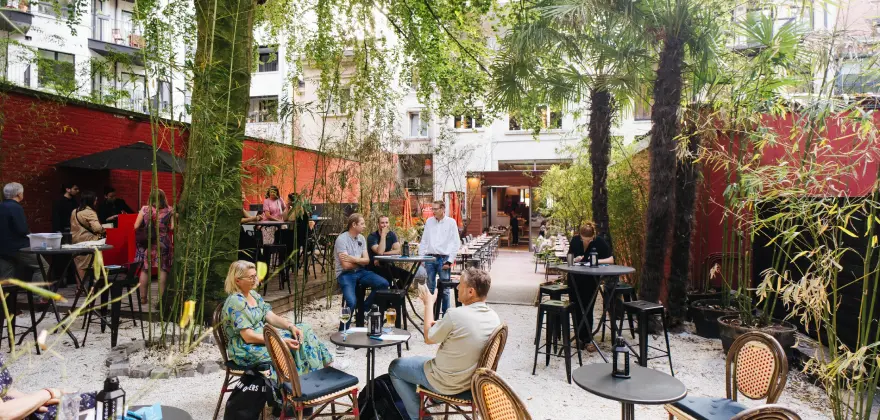
Sentro
Located in the heart of Brussels, Sentro offers an exceptional festive dinner on 24 December from 7pm, with a sumptuous menu. Restaurant Sentro offers a 6-course Christmas menu for €125 per guest, excluding drinks.
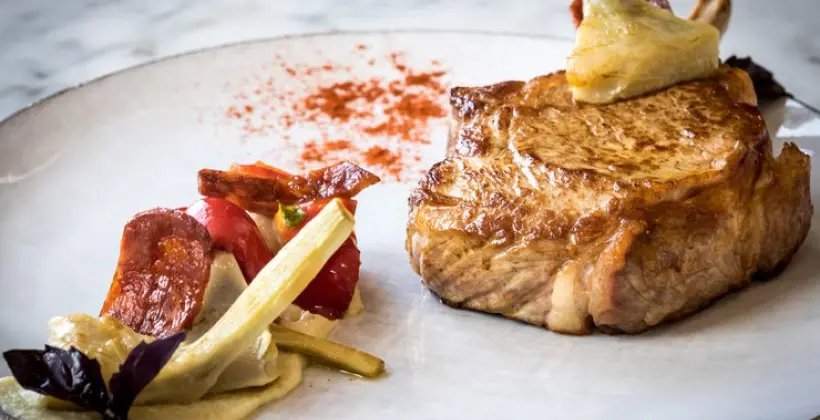
Taverne du Passage
This emblematic Brussels restaurant, located in the Galeries Royales Saint-Hubert, offers menus adapted to vegetarian diets. It offers a new identity and a new style.
The Taverne du Passage in Brussels is offering a Christmas menu for €49 per person.